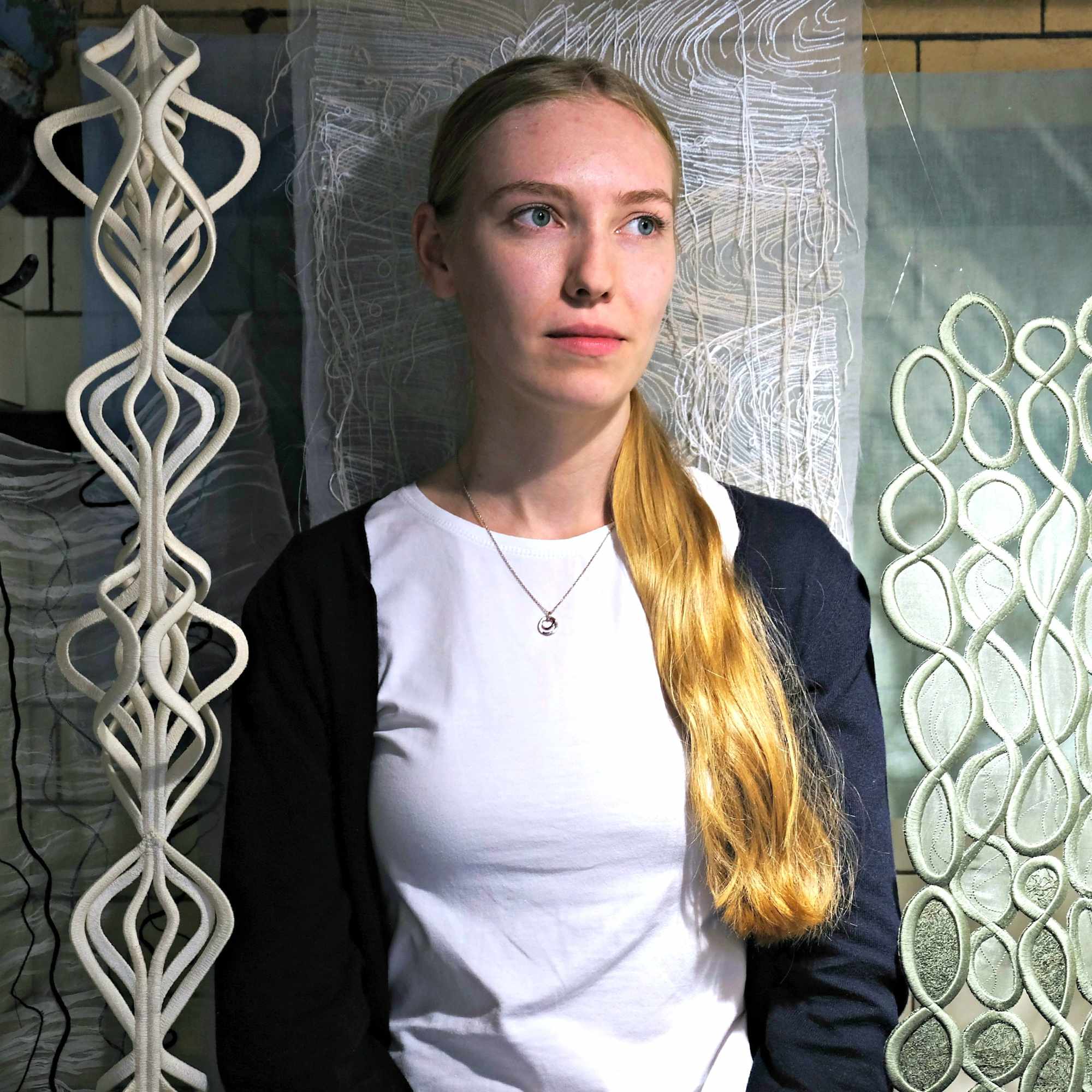
Amelia Wylam
BA Textile Design, Nottingham Trent University, 2025. “I am inspired by the beauty of nature and the potential of natural resources,” says Amelia. Her collection Wisps of Light explores shifting sunlight’s reflections and shadows which, for Amelia, express earth’s natural rhythms with a positive effect on wellbeing. “I found that the patterns of natural light brought me feelings of calmness, grounding and presence – I wanted to capture their benefit and beauty.” Embroidered wall hangings echo these subtle contours and celebrate natural colours. Amelia has worked with silks, natural dyes, biodegradable thread, bio-sequins, and innovative root fabric – “to reduce my chemical impact and share the potential of nature’s materials.” Her Knitted into Nature handbags were made from biomaterials such as root fabric, orange peel leather, knitted banana peel and grasses – nature’s answer to fast fashion. Embedded with seeds, they will grow after use. “After showing with GREEN Grads I feel inspired to test new ideas and motivated to continue developing my products.”
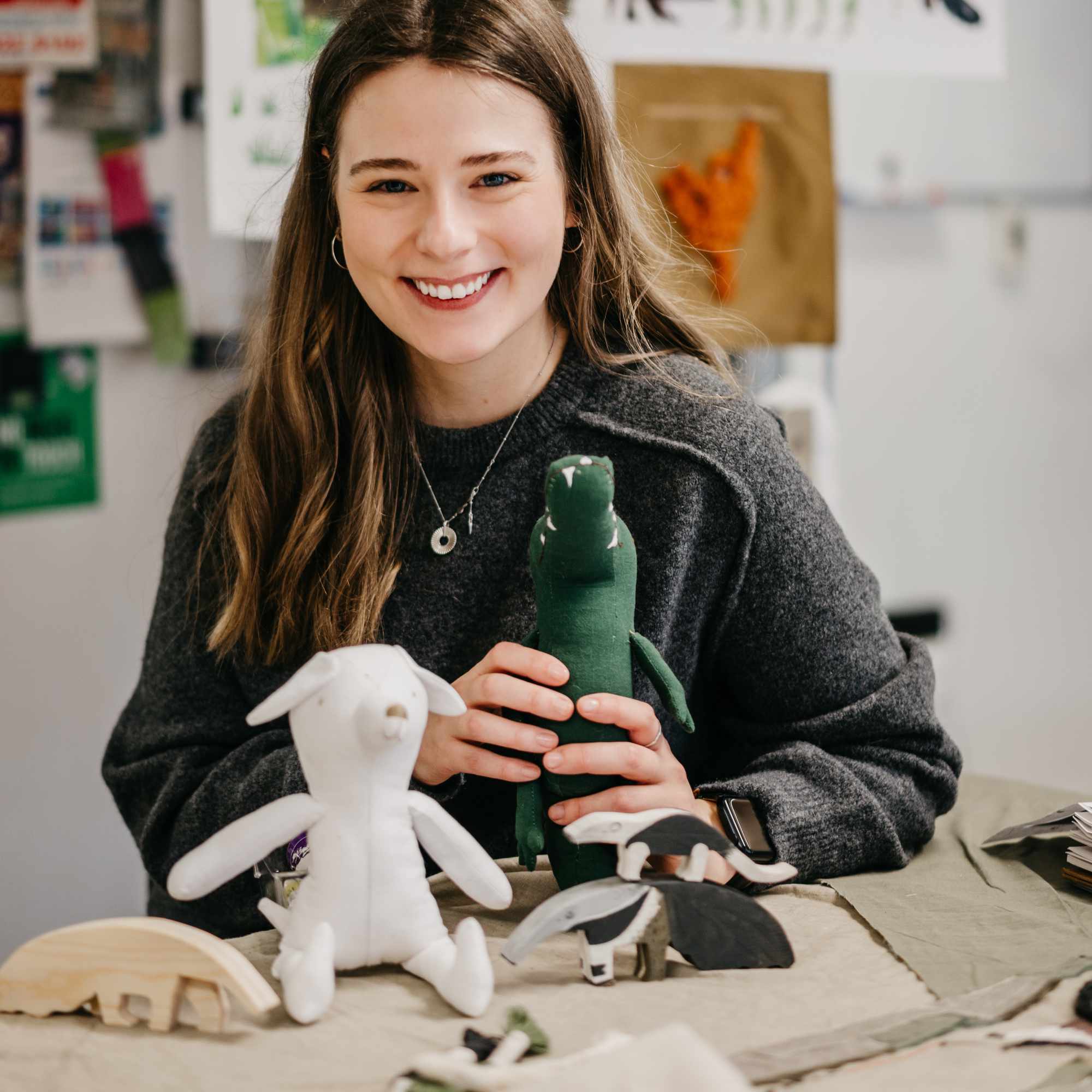
Ames Newton
BA Textile Design, Birmingham City University, 2025. Ames has created a multi-faceted collection for children that explores the world of the giant and lesser anteater “because they are critically- endangered, interesting creatures and aren’t usually found in design.” She has included books, clothing, wall hangings and furniture. This vivid graphic exploration of an endangered species, full of facts, engaging details, personality and colour, is Ames’ response to climate crisis and declining biodiversity. Ames has won the Bradford Textile Society’s British Wool Award for the carpet/rug category.
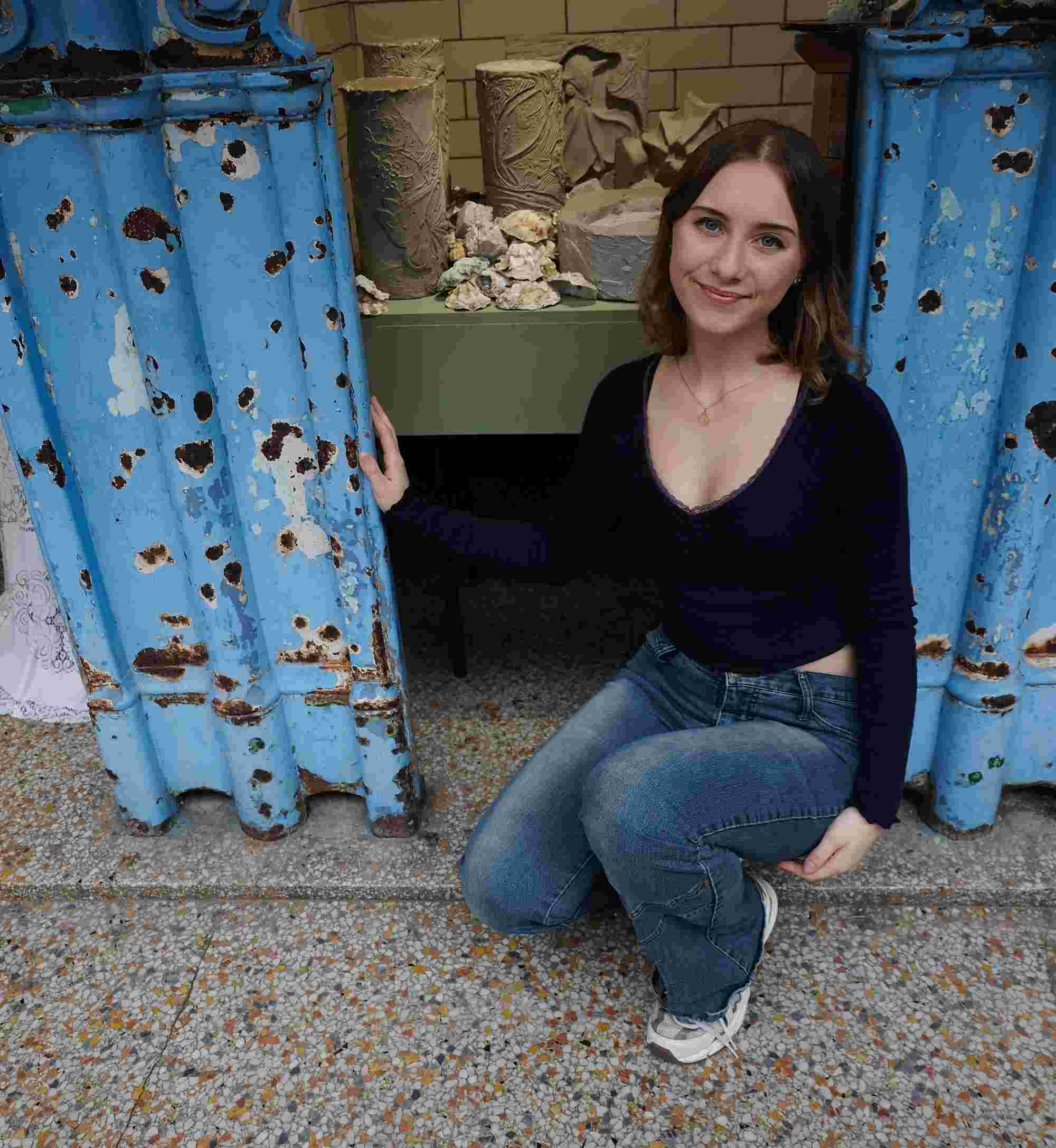
Charlette Costin
BA Textile Design, Loughborough University, 2025. Charlette’s project Out of Sight investigates the mass destruction of our oceans caused by the widespread practice of bottom-trawling. This wasteful and damaging way of fishing drags heavy nets and chains along the sea floor, capturing everything in their path. They bulldoze fragile underwater habitats and also release carbon from the seabed. As only one or two species are wanted, more than three quarters of everything else that is caught may be thrown away as “discards.” Charlette has made small-scale prototypes of structures that that could sit on the sea bed to prevent trawlers from operating, together with oyster-concrete cylinders to restore seagrass and oyster habitats. “I am motivated by my love of the ocean as a scuba diver. Charlette’s beautifully-embossed cylinders are evocative of creatures of the deep. “They could regenerate depleted sea grass and oyster habitats. They combine a visual protest with a practical solution.” Charlette was short-listed for New Designer of the Year at New Designers 2025.
Claire Malley
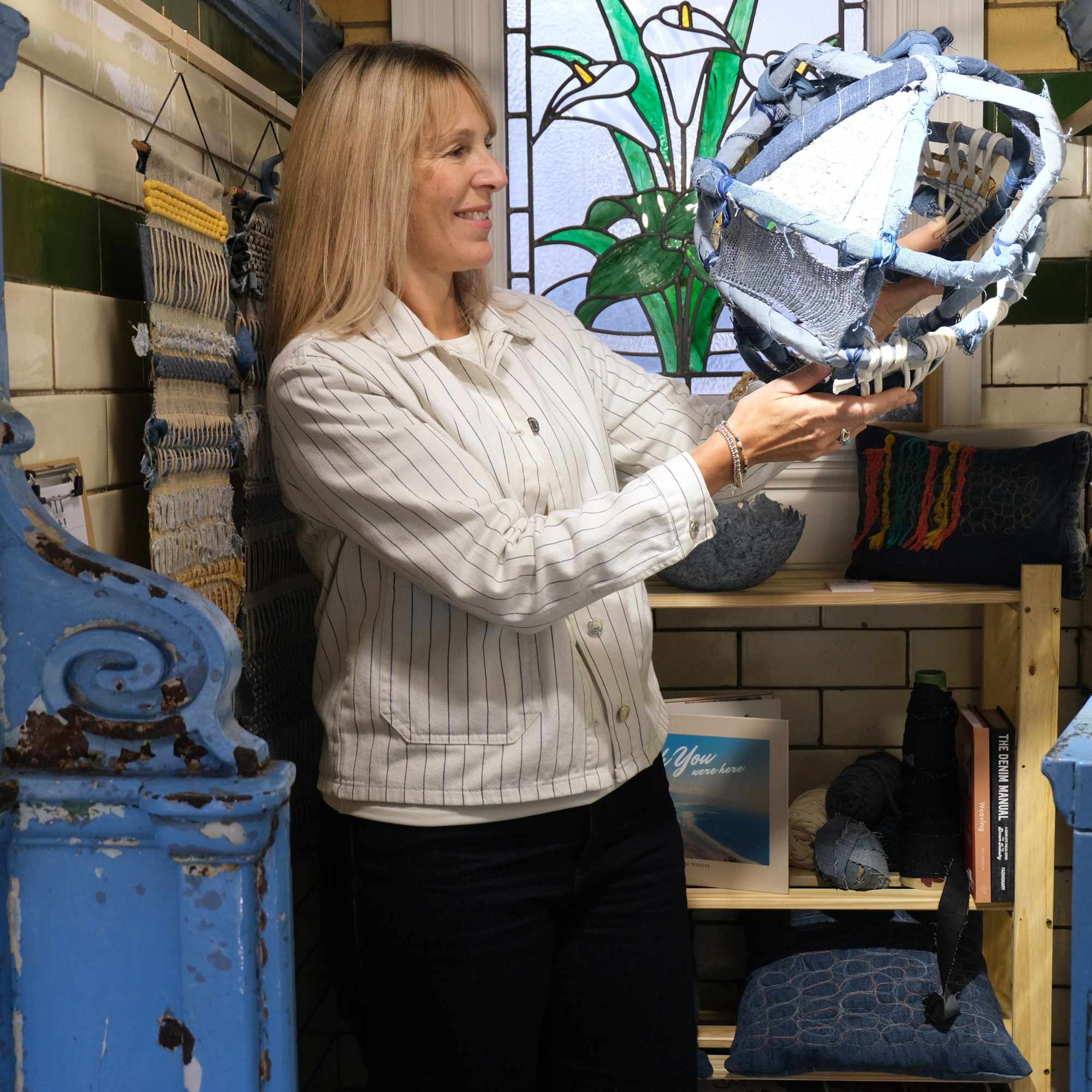
MA Textiles, Manchester Metropolitan University, 2025. “I am creating/nurturing dialogues about the creative potential of textile waste – and spotlighting the need for more sustainable design.” Claire’s wall hangings are woven from denim waste and handmade paper panels/artwork fashioned from fabric off-cuts and recycled yarns. The panels, which have acoustic properties, can be made to any size with a variety of stitched designs and patterns. Mounted in a frame, they can become a screen or room divider. Claire has extensive experience in organising and running community workshops. She was Vita Group winner at Liberty London in the Embrace the Selvedge 2025 Design Project, reflecting the essence of Liberty with bold contemporary fabrics for welcoming community spaces. She presented fabric designs, woven wall hangings and handmade paper panels made from waste.
Daisy Lashmar
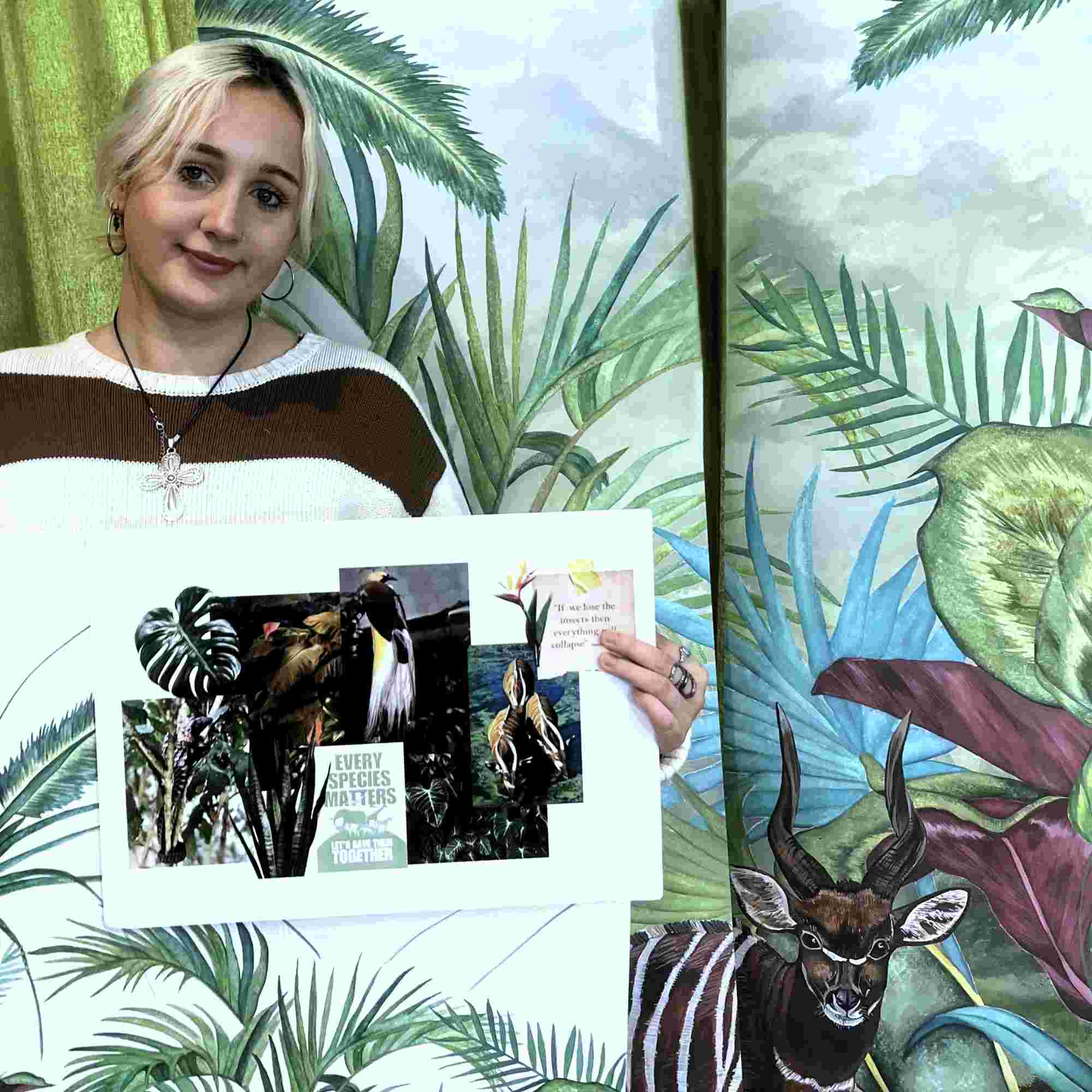
BA Textile Design, Nottingham Trent University, 2025. Daisy has created a fashion/interiors collection that actively raises awareness of endangered ecosystems. “It’s global storytelling through design and spotlights two of the world’s most bio-diverse but threatened regions, Papua New Guinea and the Congo Basin.” Daisy is using interiors and nightwear as perhaps unexpected platforms for environmental consciousness – “because the loss of even the smallest insect ripples back to affect humanity.”
Elliot Morgan
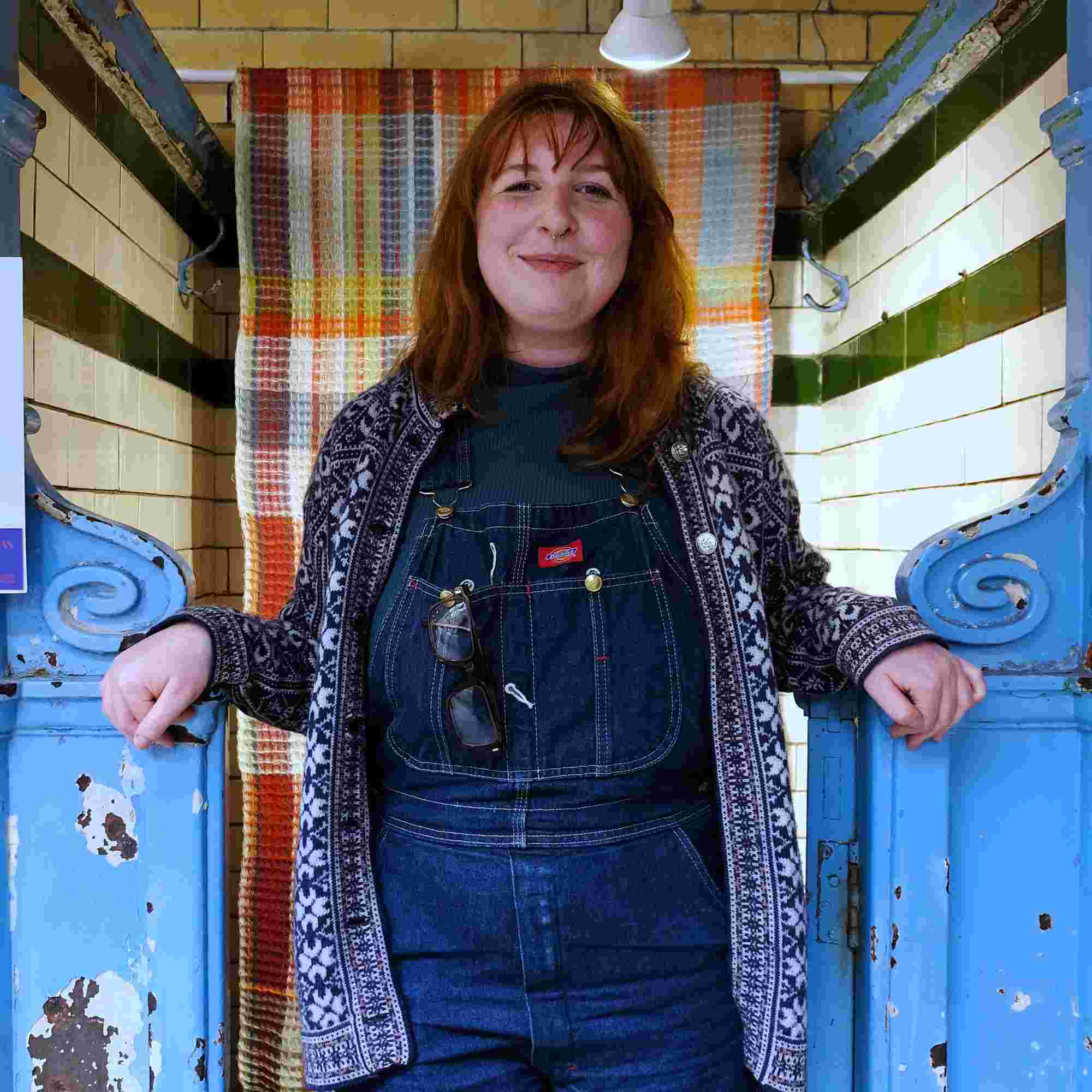
BA Textile Design, Falmouth University, 2025. “My work is a quiet response to a world shaped by division, conflict and environmental crisis. It celebrates our shared humanity and connection to nature, weaving together images and colour to express identity, memory and relationships.” Elliot has made biodegradable textiles which combine photographic jacquard weaving with traditional constructions and natural dyeing. “I explore women, sexuality and human relationships with stories of wider ecological and cultural concern.” This dedicated young weaver has won numerous commendations for her use of wool from the Bradford Textile Society, and was selected for their Autumn 2025 Centenary Showcase.
Freya Boothroyd
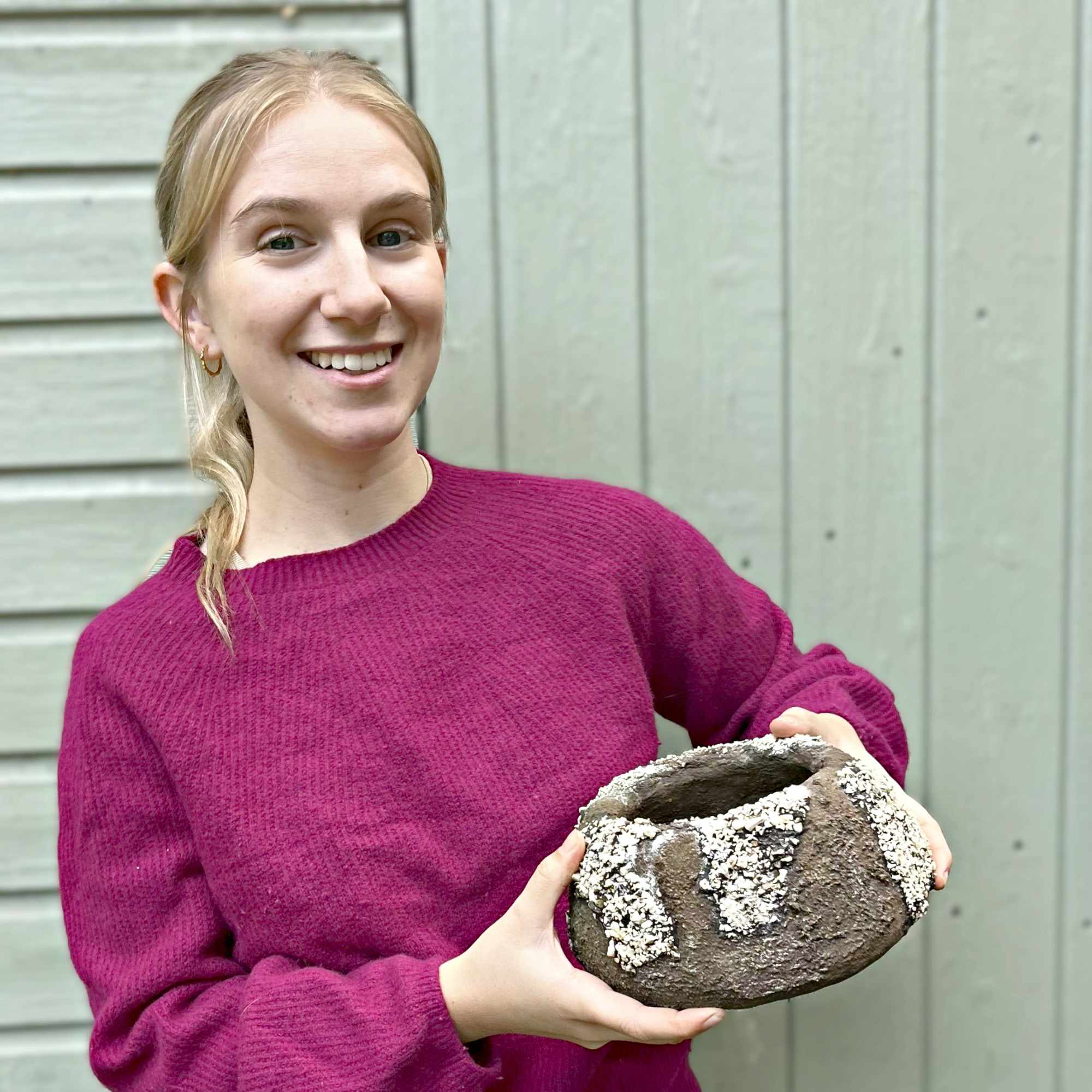
BA Product Design and Craft, Manchester School of Art, 2025. Freya’s work “investigates the materiality of the Peak District National Park.” She comes from a family of geologists and cavers. Using wild clay that has been left untouched for centuries, and personally gathered from caves, along with other materials responsibly taken direct from the land, Freya explores local geology and ecology, documenting her process with film and photography. Working within the caves themselves, she creates striking strongly-textured pots, sculptures, prints and video. “I am expanding my relationship with and knowledge of the land that I have grown up in, in the least destructive way possible.” This is her passion and her mission. Freya won the Department of Design Manchester School of Art Design Contexts Award, 2025.
Gagandeep Heer
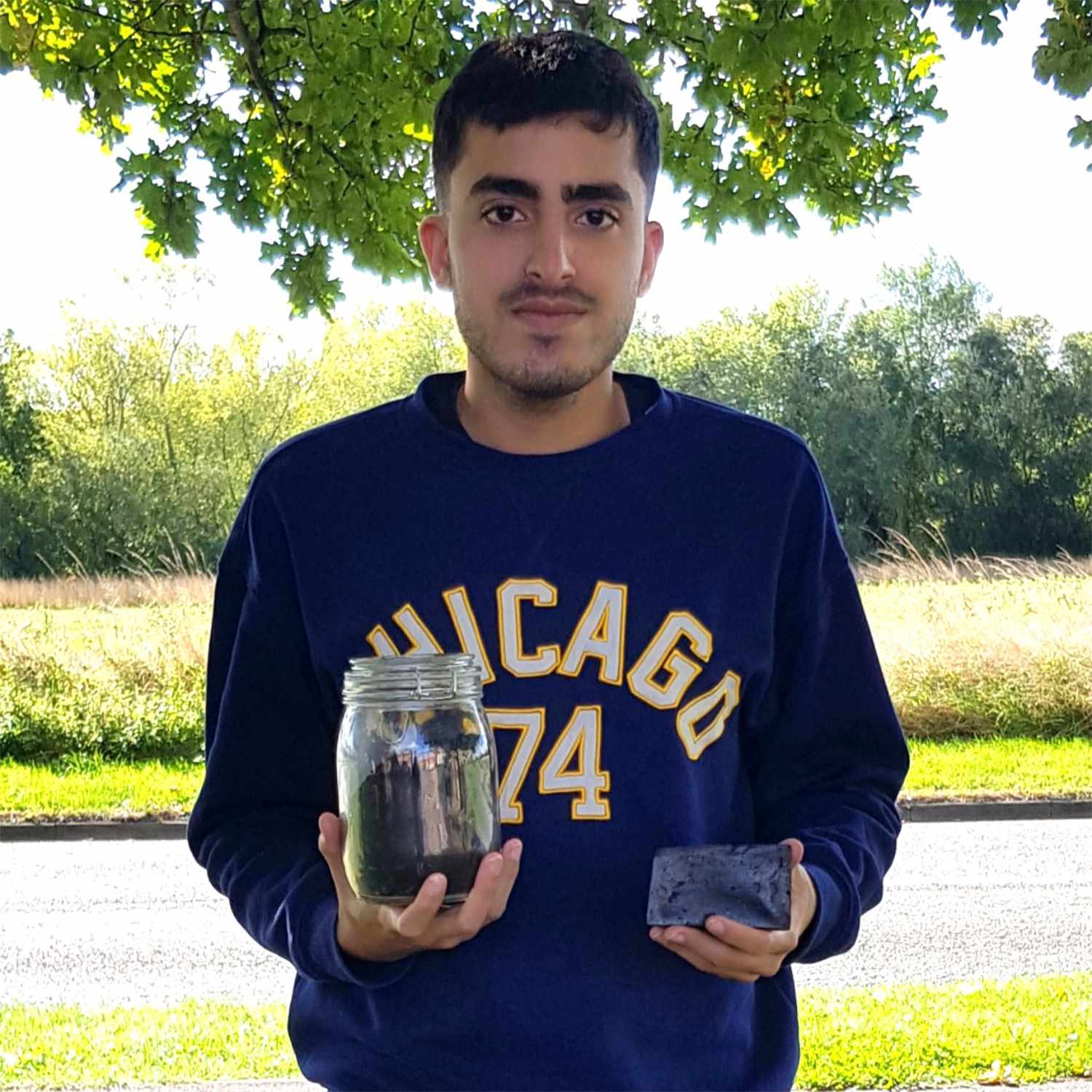
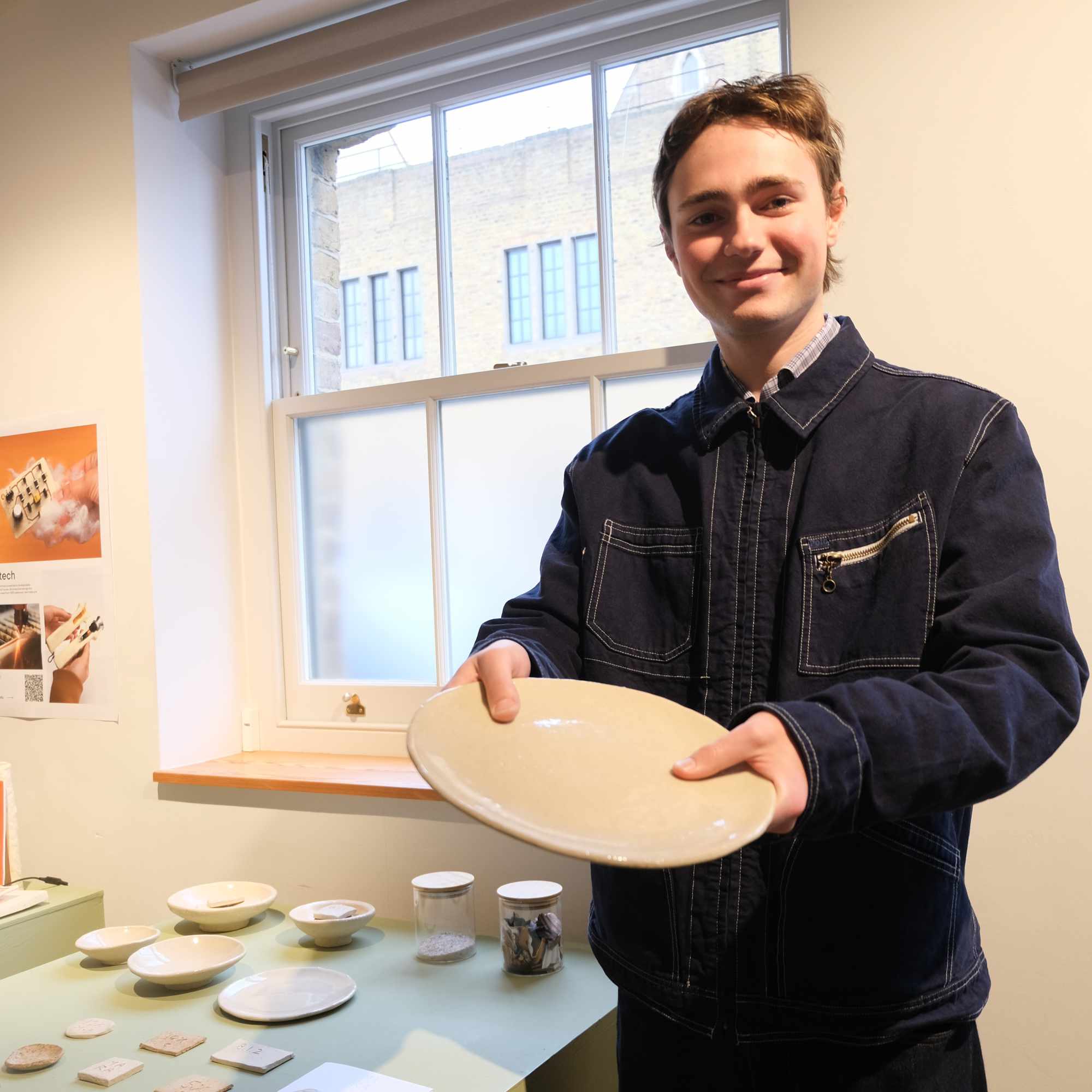
BA Product Design, Nottingham Trent University, 2025. The UK produces around 500,000 tonnes of waste coffee grounds a year adding 1.8 million tonnes to carbon emissions. Gagandeep’s Grounded is a biodegradable composite made from coffee grounds, orange peel and natural binders, which can be cut, sanded, drilled and moulded. This material could be an ecological alternative to virgin materials such as clay, which cannot be re-used once fired. Gagandeep has made vessels and tiles. Grounded could also be used for architectural panels as it has potential for noise and heat insulation. “I would like to develop more materials from readily-available food waste; and to run inspirational workshop for children and adults as an introduction to regenerative materials.” Gagandeep has won a Silver Creative Conscience Award 2025 for Product and Structural Design in the category Environment + Sustainability.
Kimmy Rose Danby
BA Textile Design, Leeds Arts University, 2025. “I am developing sustainable materials for functional design.” Kimmy Rose has made a porous cement mix that fosters the growth of plants around buildings. She has also experimented with bio-plastics for lampshades, providing lifecycle assessments of their environmental impact. “I don’t want my work to feed the cycle of waste and harm caused by plastics and other unsustainable resources. I want to design and create materials that not only avoid damage but actively support the environment, showing that design can be both imaginative and restorative, for a more hopeful and sustainable future.”

Leah Gasson
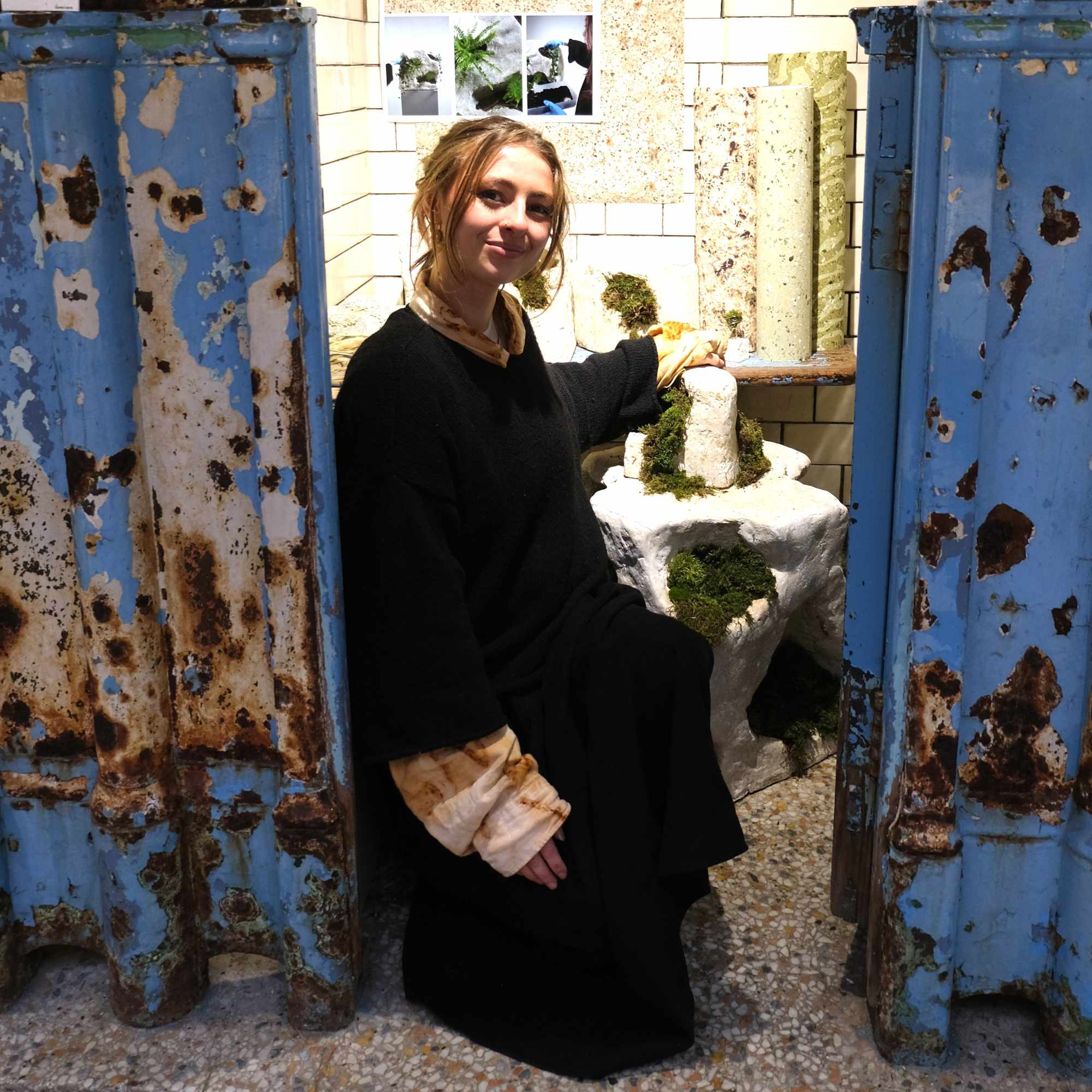
BA Textile Design, Loughborough University, 2025. How about a “grown” wedding dress, “co-created with nature”? This would be embedded with seeds that you can compost after use, whereupon it will sprout new growth as a green memorial of your love. Step forward The Ephemeral Bride developed (and modelled) by Leah Gasson. It took much painstaking research – and lots of trial-and- error, and experiments with many natural materials and processes. The bodice is a grass roots fabric, paper and alpaca, and the skirt an embroidered repurposed antique table cloth. “I want to challenge the lifecycle of the contemporary wedding dress and create a stronger emotional relationship between wearer and dress.” Leah won the UltraFabrics Sustainable Design Award at New Designers this year, and also the GF Smith Award.
Maddie Sturmey
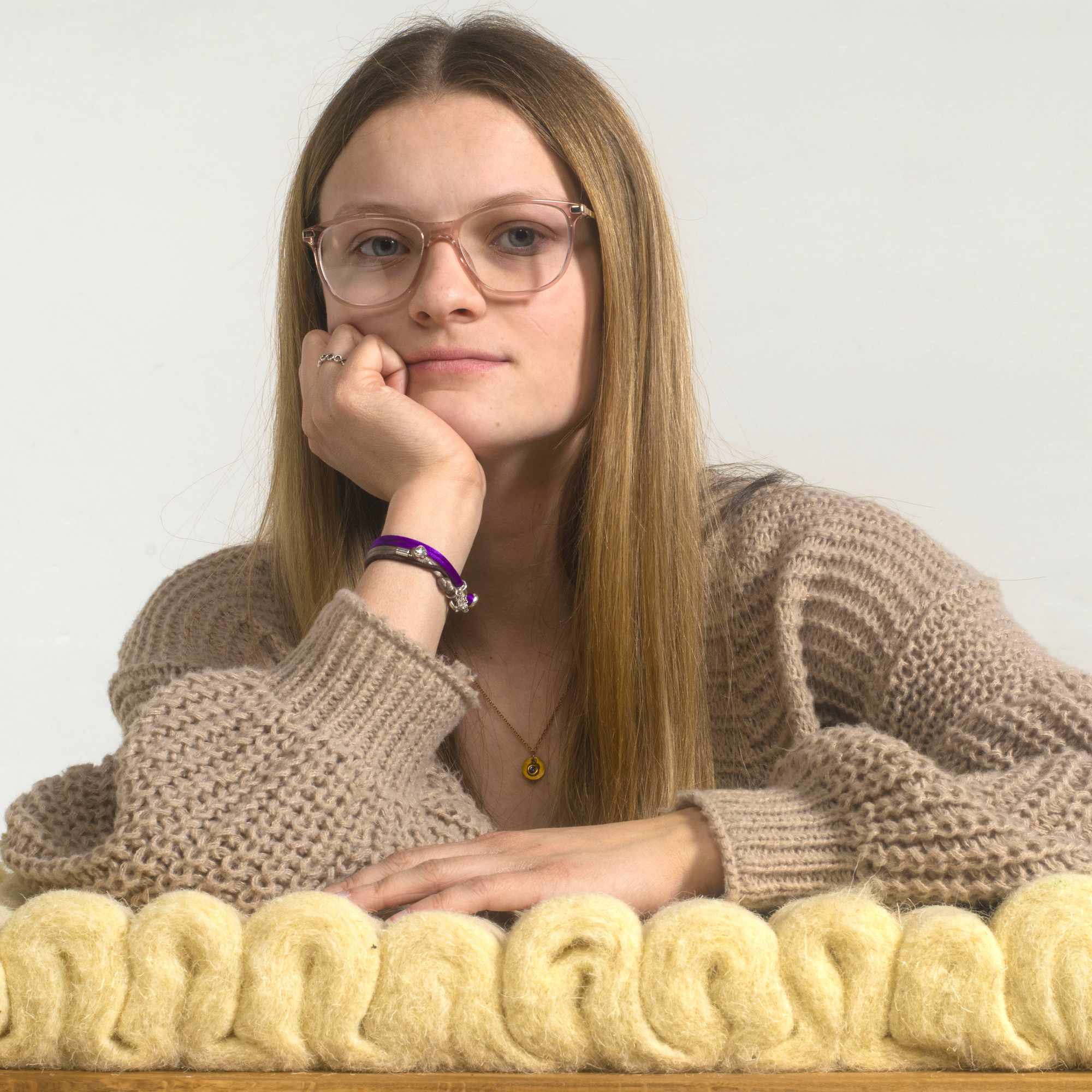
BA Product Furniture Ceramics, University of Staffordshire, 2025. Cwtch is Welsh for hug – and the name of Maddie’s inviting and cosy wool-topped benches and stool made from reclaimed materials. Timber garnered from an old oak dining table is used for the frames of her charming seating, with walnut dowels for contrast. She has used traditional joints rather than metal fixings for beauty and ease of disassembly. The seats, removable for cleaning, repair or replacement, are made from uncovered waste wool or from wool that is a by-product of the packaging industry. This is ingeniously “pleated” into the frame. “Sheep’s wool, often thrown away, is a severely undervalued resource.” Maddie adds: “Now I’ve tasted wool as a material, and made great connections in the wool industry, I aim to use wool in many innovative ways. I have learned how important it is to hold sustainability at the heart of any design process, and I hope to implement this within industry…”
Maria Fernanda Varney
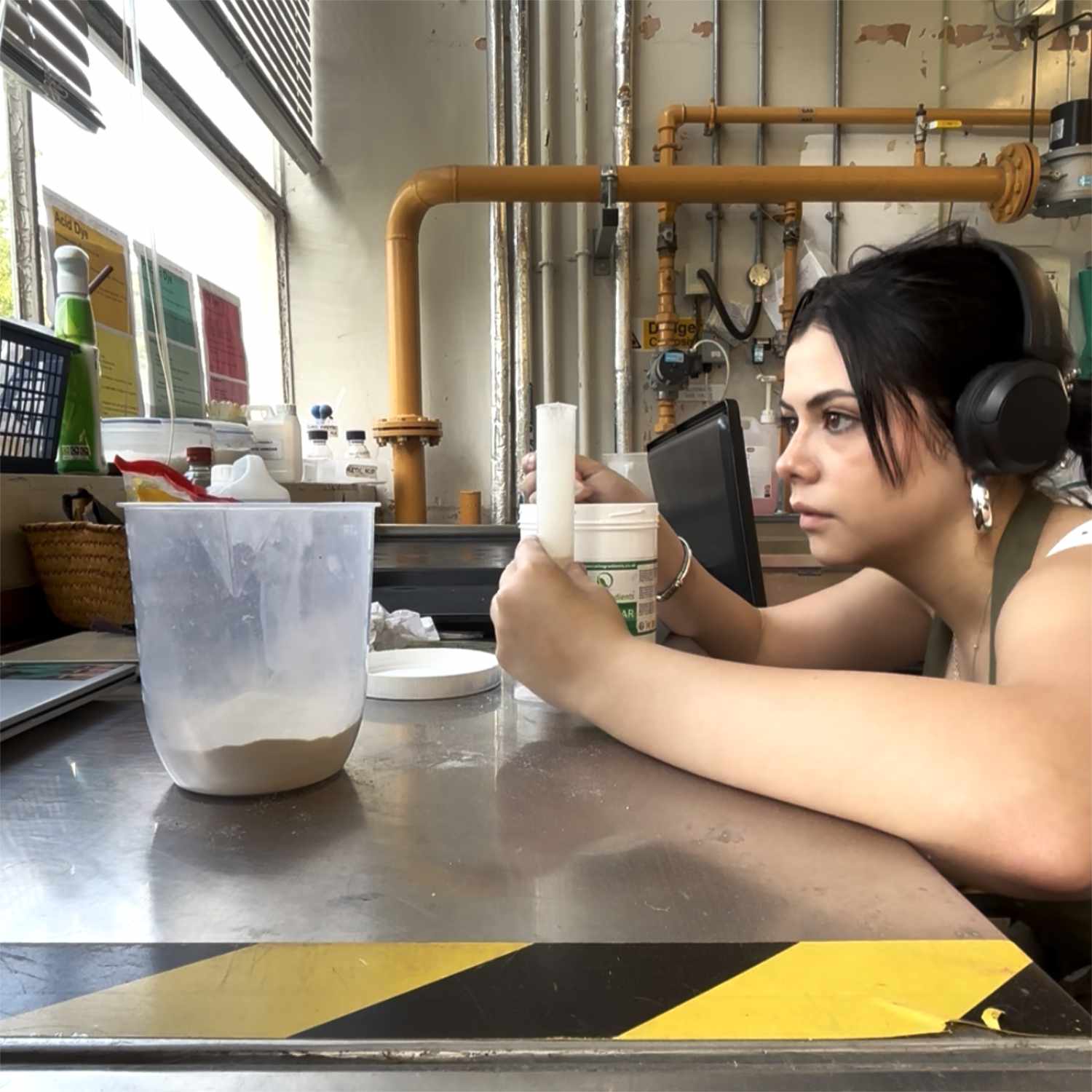
BA Textile Design, Loughborough University, 2025. “We need seriously to rethink fashion materials, asserts Maria. Her project/installation Material Rehabilitation challenged the sustainability of leather and denim. “I’m proposing biodegradable alternatives that parallel these dominant textiles.” Maria uses “sensory engagement and trompe l’oeil” to make people focus on materials and conscious design. “At its core, my project is a call to reassess the environmental legacy of our collective material choices.” Her I can’t believe it’s not leather jacket – which truly lives up to its ambitious title – is made from three different biomaterials. Maria won the Refab Studio Award for Innovation in Upcycling at New Designers, 2025. “Amongst other things, this recognised my use of plant litter from campus waste streams.” Maria also won the A.W.Hainsworth Innovation in Material Award at her University textile degree show, 2025.
Martha Lawton
BA Textiles in Practice, Manchester Metropolitan University, 2025. Marth’s project At the river explores the highly-topical issue of pollution within our waterways in a series of woven woollen paintings using natural dyes and materials. Enthused by community projects like the Friends of the Dart, Martha is translating the words, data and science around water pollution into “a tangible tactile material that makes people view this issue in a different way.” After reading To Dye For by Alden Wicker, Martha was galvanised by the state of our textile industry. “This book revealed the untold effects of chemical dyes and fabrics in our clothes, and their toxic effects on us and the environment. Channelling this frustration and the recent headlines around water pollution in our rivers, I created slow textiles that do not harm the environment around us.” Her naturally-dyed colour palette was inspired by photos of her wild swimming in her local river. Martha won the UK finals of the SDC (The Society of Dyers and Colourists) Colour for Good – Creativity in Adversity Award. And she won the Camira Circular Design Award at New Designers, 2025.

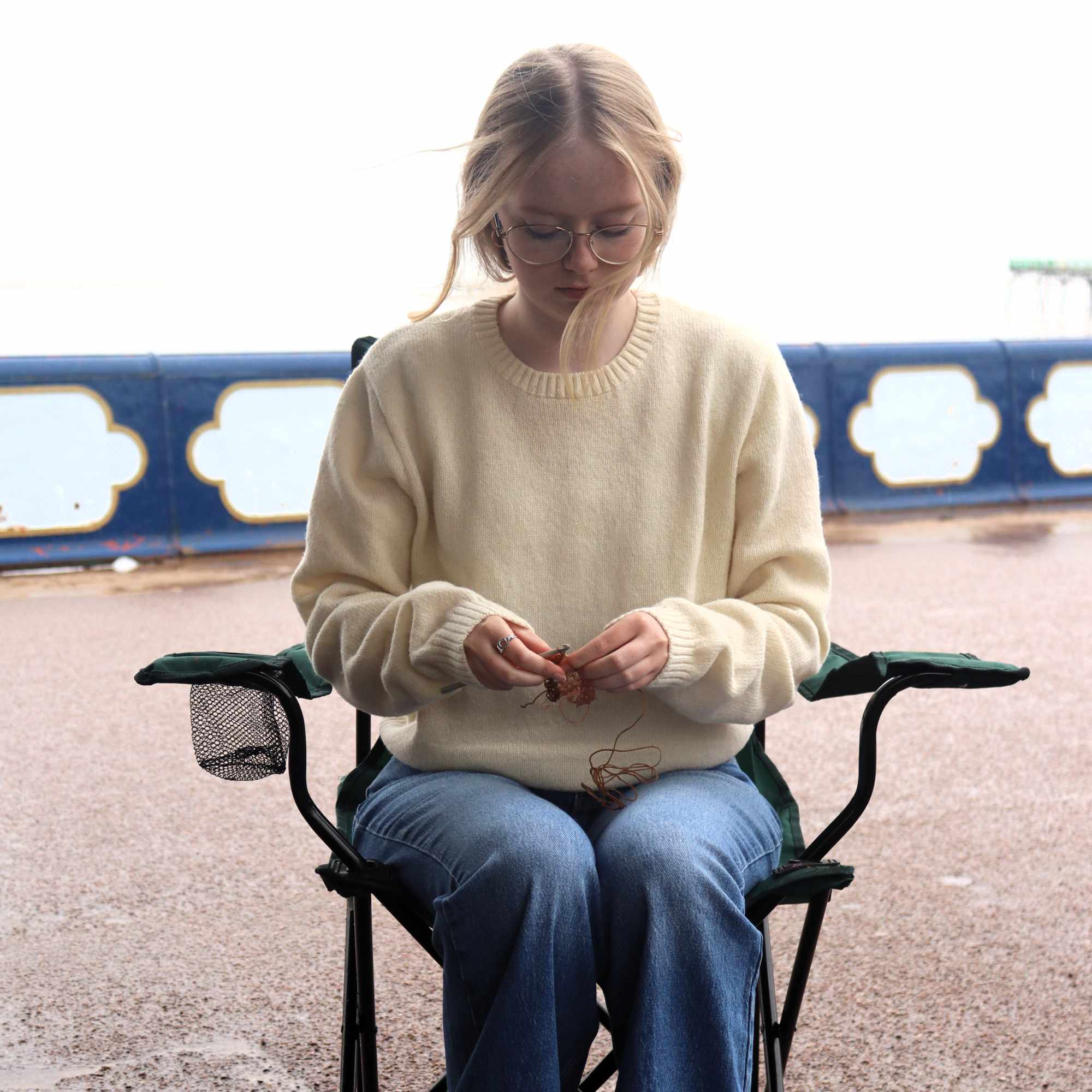
Megan Morley
BA (Hons) Textiles in Practice, Manchester Metropolitan University, 2025. Megan is exploring algae as a sustainable alternative to plastic materials. Growing up in the seaside town of Blackpool, she saw quantities of single-use plastic packaging littering the beaches, harmful to wildlife because it never fully degrades She has done material research to make and refine an algae-based yarn which is biodegradable, non-toxic and naturally dyed, thus a suitable substitute for single-use plastic packaging. “Although sustainable packaging is slowly emerging as an alternative to plastic, I believe change needs to happen faster to combat this ever-growing issue.” She stresses the versatility of seaweed/algae – “a widely-available substance which can be used as a food, biofuel, and dye. Megan won the Material Source: Material Innovation award 2025 and was highly commended for the Design Global Vision: Creative Solutions Award, 2025.
Milly Vine
BA Textile Design, Nottingham Trent University, 2025. Through her project, Reclamation of Space, Milly imagines a post-apocalyptic world reclaimed by nature, exploring the future of fashion through botanically-inspired textiles. She presents biodegradable materials that leave no trace, using natural and/or repurposed resources. And on these she has experimented with engraving, laser cutting and naturally-made embellishments – “in a new and playful manner.” Milly is committed to sustainability: “It has driven my research into the regenerative fabrics that could reshape the textile industry in a slower, more conscious future.” Milly won Best in Show for Print, and best Technical Knowledge Prize in her final year at University.
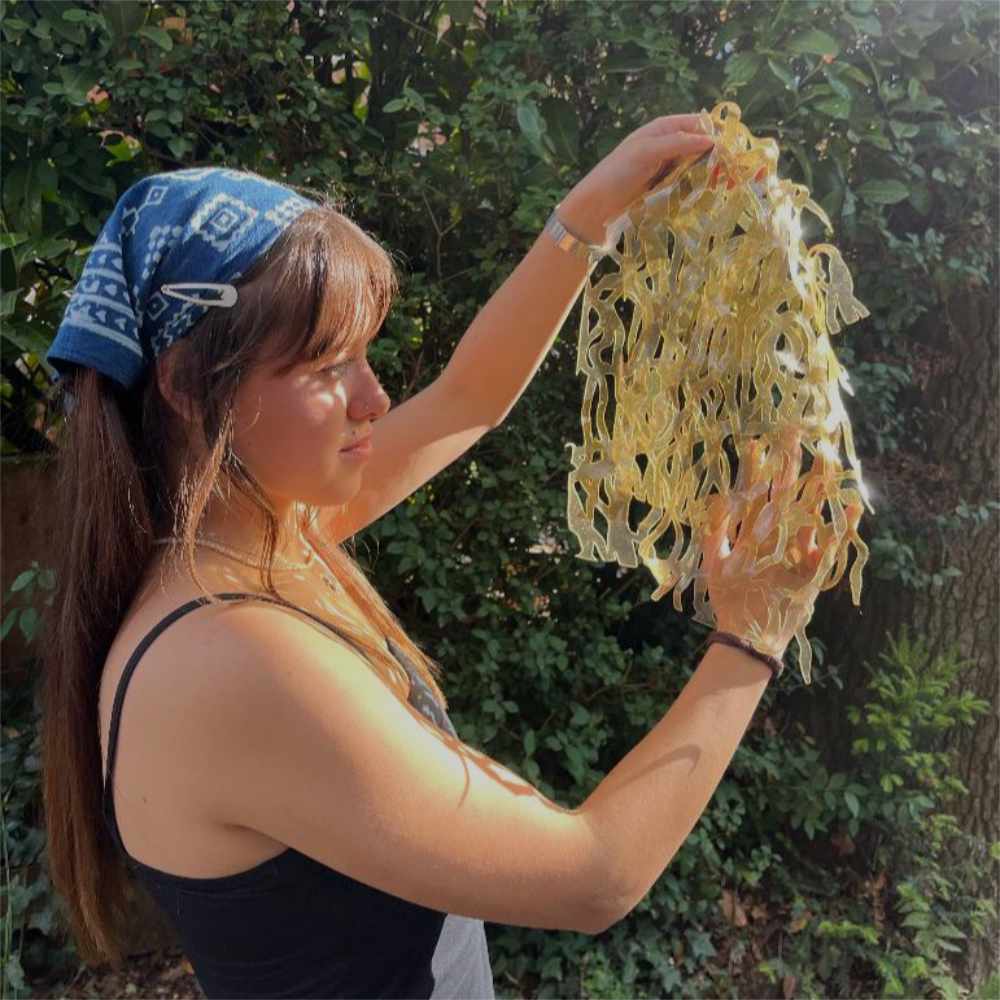
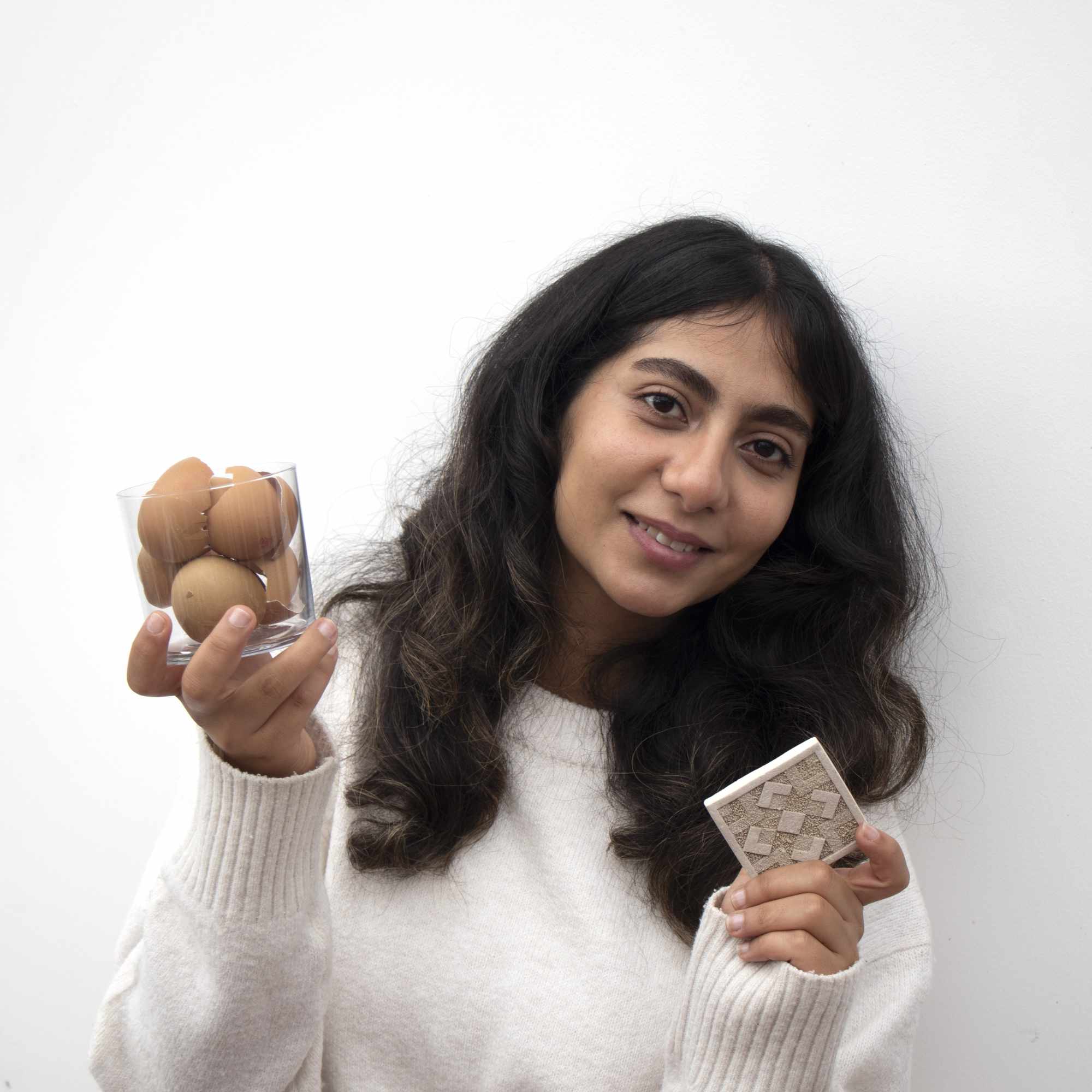
Mobina Rajabimoghadam
MSc Product Design, Manchester Metropolitan University, 2025. Mobina has invented Egshel, a truly biodegradable biomaterial from waste eggshells, transforming this food by-product into a sustainable resource. Her material with its appealing aesthetic is relatively inexpensive and comes in various thicknesses. It’s fully compostable and acts as a natural fertilizer. It’s also moldable, machinable and compatible with CNC and laser cutting. A thin version is translucent, printable, foldable, and self-adhesive. It can even be embroidered. Mobina has made flat-pack modular lamps from her new material, with interchangeable shades, that are repairable and can be upgraded if wished. This diverts waste from landfill, reduces shipping emissions, and decreases reliance on virgin resources and industrial recycling. Mobina adds: “Materials made from unavoidable organic waste, such as residues from food production, are one of our most underutilised resources. While biomaterials have gained traction, their use in industrial design is still poor. Accordingly, I have developed my material for machinery and manufacturing.”
Robert Radcliffe
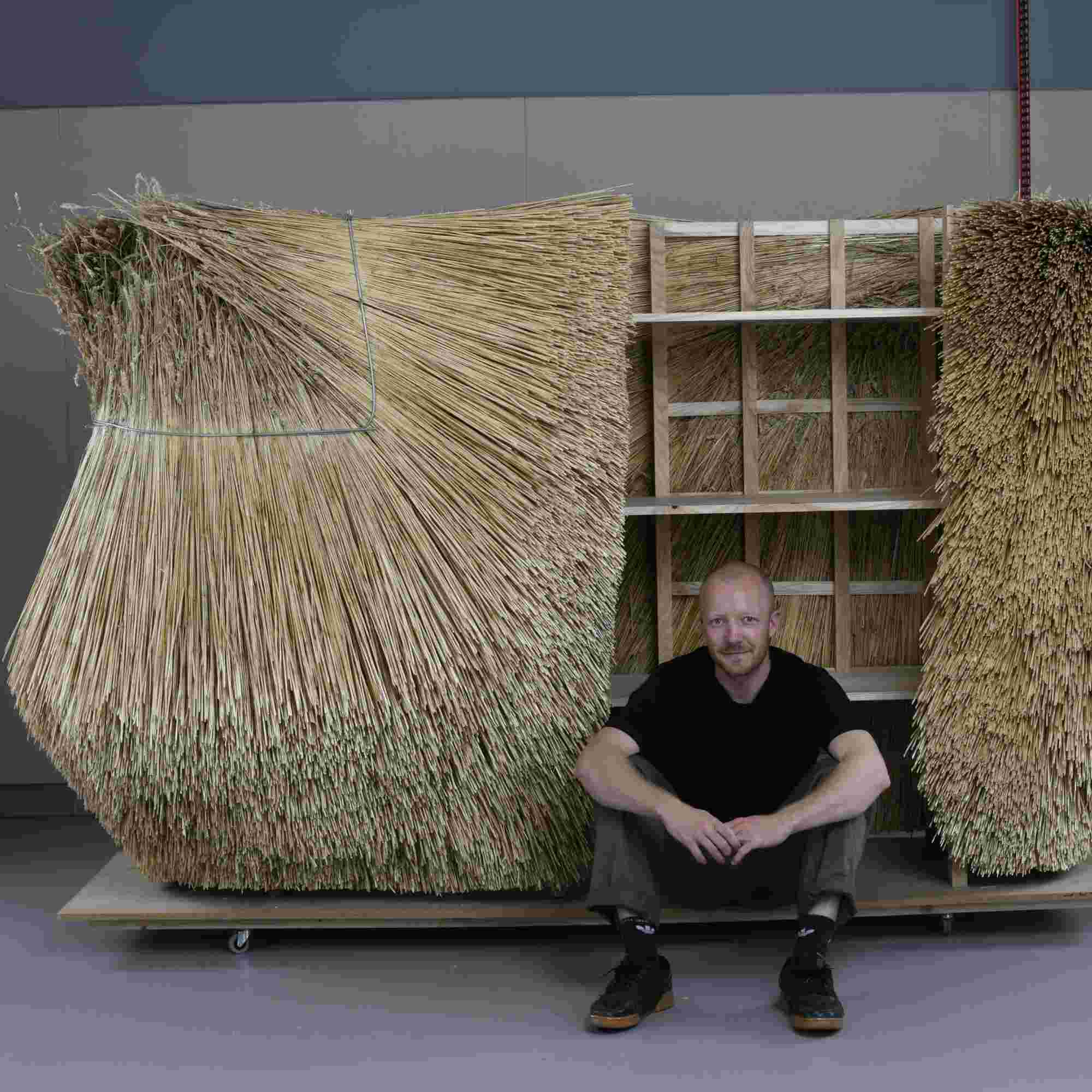
MA Product and Furniture Design, Kingston University, 2024. Create Programme, Snowden School of Furniture, 2025. For his project Re-thatched, Robert researched in detail the characteristics, techniques and materials of thatching across the UK. His aim? To apply these traditional craft practices to contemporary furniture design. The result? An impressive “thatched shelf”, 2.4 metres wide, which “symbolises the preservation and adaptation of heritage in contemporary life.” Inspired by the corner of thatched roofs, this is a dramatic example of the surfaces, textures, and shapes of thatch. Robert has also made a thatched oval mirror, available to commission and lights with flat wooden sections joined with twisted copper wire – “a process a bit like knitting or crochet.” Robert adds: “Craft, the act of making with your own hands with the materials and tools available to you locally, is innately sustainable. I hope my wider impact will be people experimenting with crafting and creating objects for themselves from the materials and tools they have around them.”
Sophie Tuck
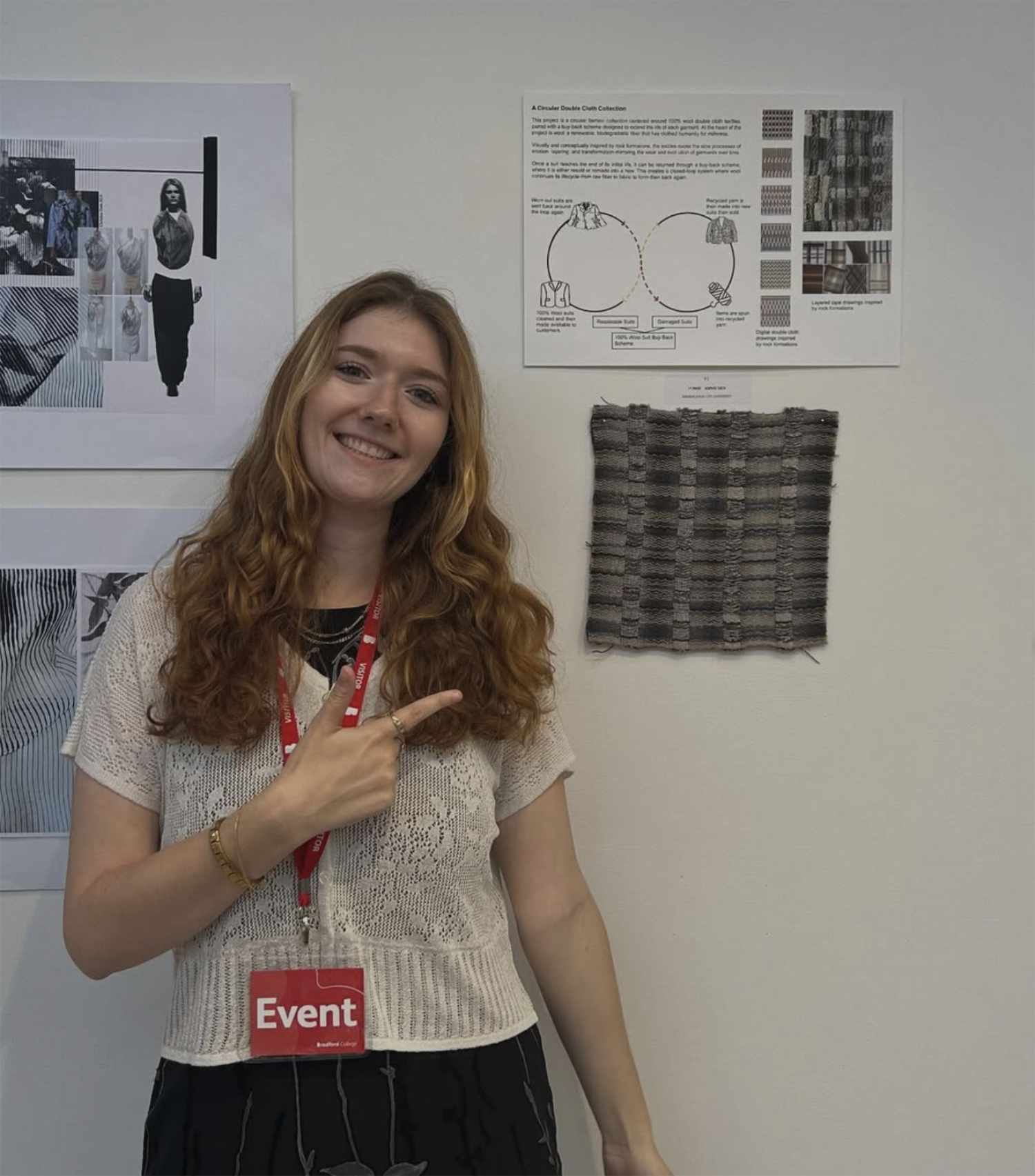
BA Textiles Design. Birmingham City University, 2025. Sophie’s Woven Wool Sediments features 100% wool double cloths for men’s suiting, inspired by the permanence of rock formations. They have sustainability at their core, being fully biodegradable, so that no trace remains beyond their lifecycle. Wool’s natural durability, breathability, and comfort make these suits long-lasting investment pieces that age beautifully with wear. “By combining timeless design with responsibly- sourced material, I am responding to a shift in consumer preferences toward sustainability and quality in men’s fashion.” Sophie has Awards from Bradford Textile Society, The Association of Fashion and Textile Courses and The Clothworkers’ Company.
Alex Clark
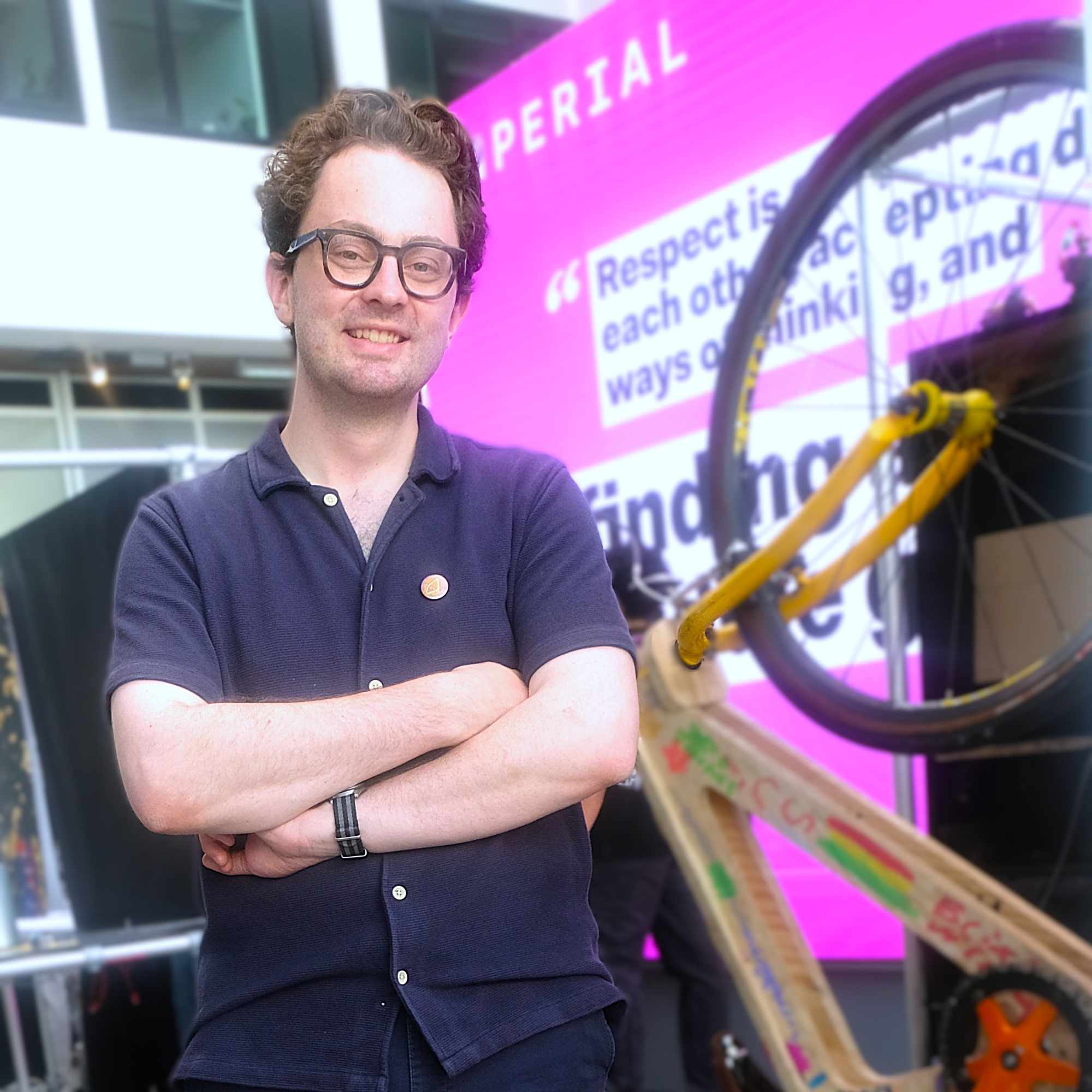
MSc/MA Innovation Design Engineering, Imperial College London and Royal College of Art, 2025. Around 11,000 bikes are thrown away every year, while funding for youth services has fallen by £1.2 billion since 2010. Alex is addressing these issues through his project The Big Bike Build. “My aim was a repairable, low-cost bicycle that connects environmental and social concerns through making.” Accordingly, Alex has created a frame of interlocking plywood components, to which salvaged parts from scrapped bikes can be attached. A working prototype was built and decorated by young people from the Angell Town estate in Brixton (developed in partnership with the charities UpCycle LDN and Brixton Wings). It also had an outing at the Ride & Thrive community event at Herne Hill Velodrome – where it completed a few laps at speed! Alex is now planning a new community hub space on the Angell Town estate. He says: “We have salvaged building materials for this. The furniture will be designed and made by young people in workshops inspired by the Big Bike Build.”
Amber Fry
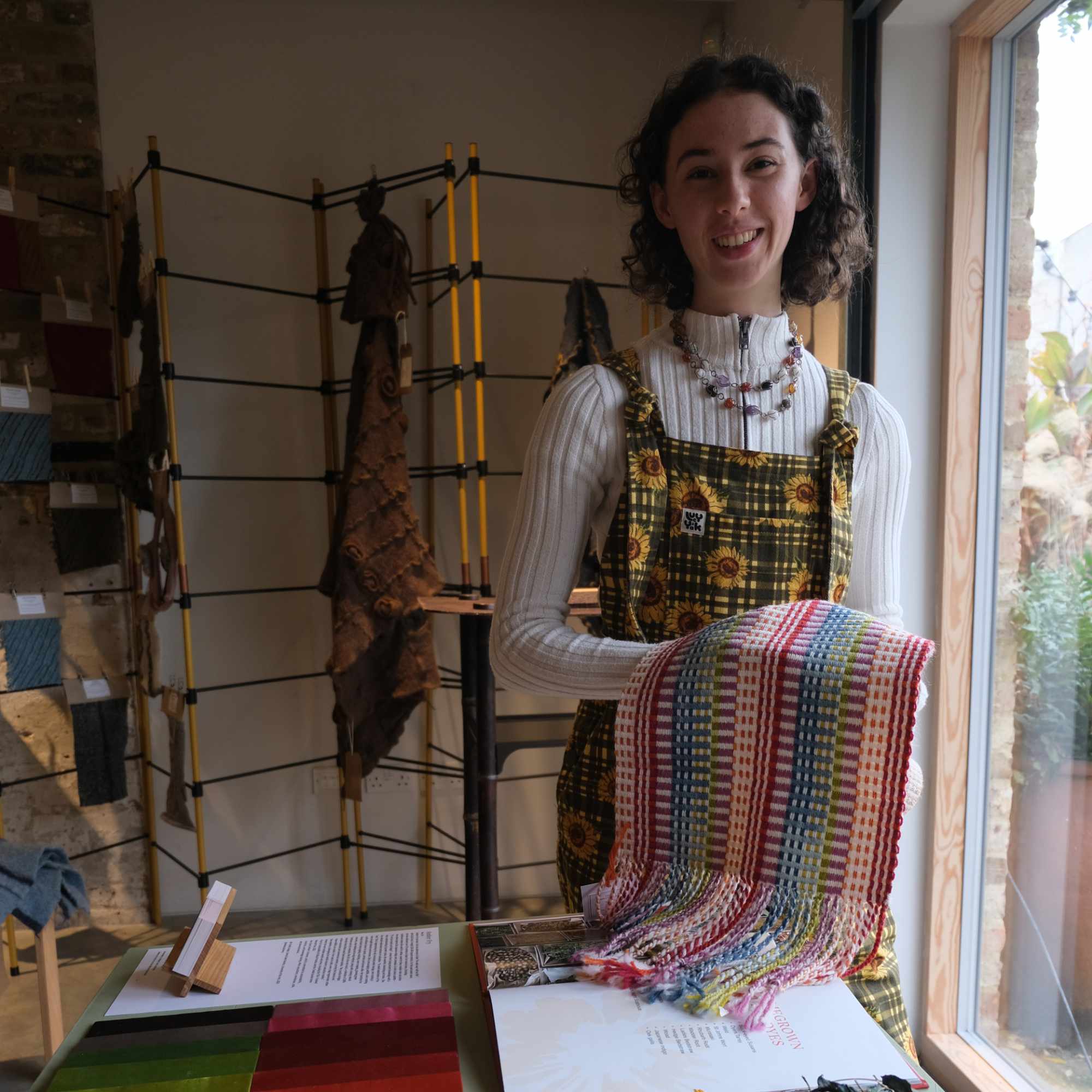
BA Textile Design, Central Saint Martins, University of the Arts London, 2025. Amber Fry has had a full-size allotment in Kent “for well over half my life” – plot 24, 10 rods in length (250-300 square meters). For the past seven years, she has cultivated over 20 varieties of plant for natural dyes, including traditional natives like weld for yellow, woad for blue, madder reds and other non-native species like Japanese indigo and coreopsis. A vivid colour palette – “it’s not just peach and beige!” – comes from fusing ancient knowledge with a deep understanding of growth cycles, the weather, harvesting and more. She has radically redirected methods of cultivation – “to avoid exploitation of the land.” She is regenerating the soil, increasing water storage, and creating a more drought-tolerant environment. She is encouraging wildlife, and creating a self-sufficient haven for plants, animals and humans alike. Her practices for change include intercropping, mulching, cover cropping, growing green manures, crop-rotating and no-dig methods, along with creating natural fertilisers and rich composts. Her project, Plot 24, is the end result, a collection of 100% naturally-dyed British wool hand-woven textiles. “My practice bridges artisan economies and commercial markets, proving that beauty and responsibility can coexist. From seed to cloth, every stage regenerates rather than depletes, challenging the textile industry’s extractive models.” Amber has won multiple awards and prizes, including the TEX+ Trustees’ Prize for Sustainability & Ethical Practice; and the Textile Society Anne Morrell Prize, 2025.
Amelie Everett
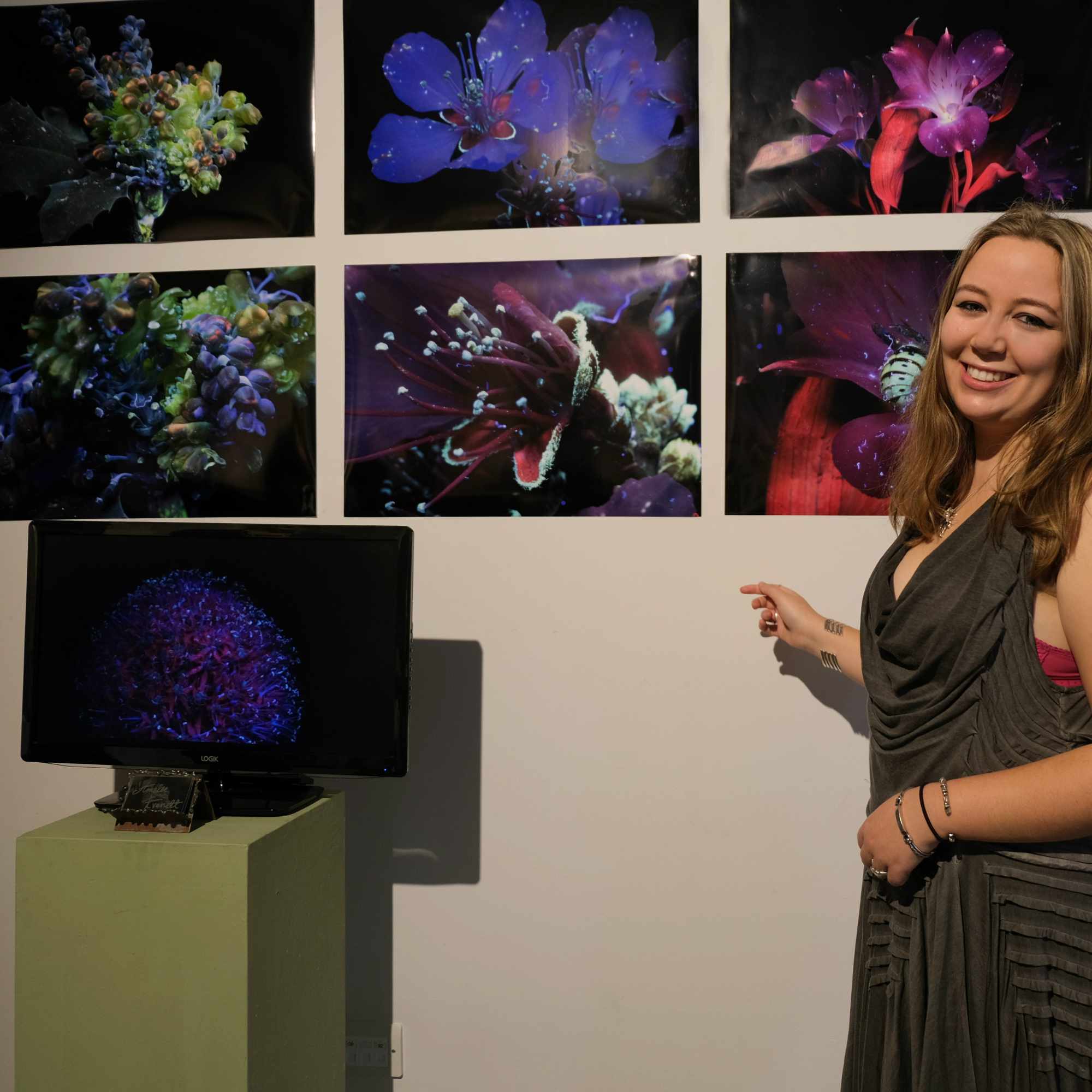
BA Graphic Design, Kingston School of Art, 2025. For her project UV Vision, Amelie is using Ultraviolet-Induced Visible Fluorescence (UVIVF) photography to reveal the hidden beauty of plants as seen by pollinators such as bees and butterflies. Her unedited images, plus a stop-motion animation, capture natural UV fluorescence, bringing these invisible interactions to life, and highlighting the extraordinary connections between flowers and insects beyond human vision. “My photography and animation reveal how pollinators navigate the world through UV vision, a perspective invisible to the human eye. I was motivated by a desire to merge science and art. With a love for biology and a passion for photography, this project became a way to unite the two, revealing the invisible beauty of nature and the hidden links beyond human vision.”
Anna Eerdmans
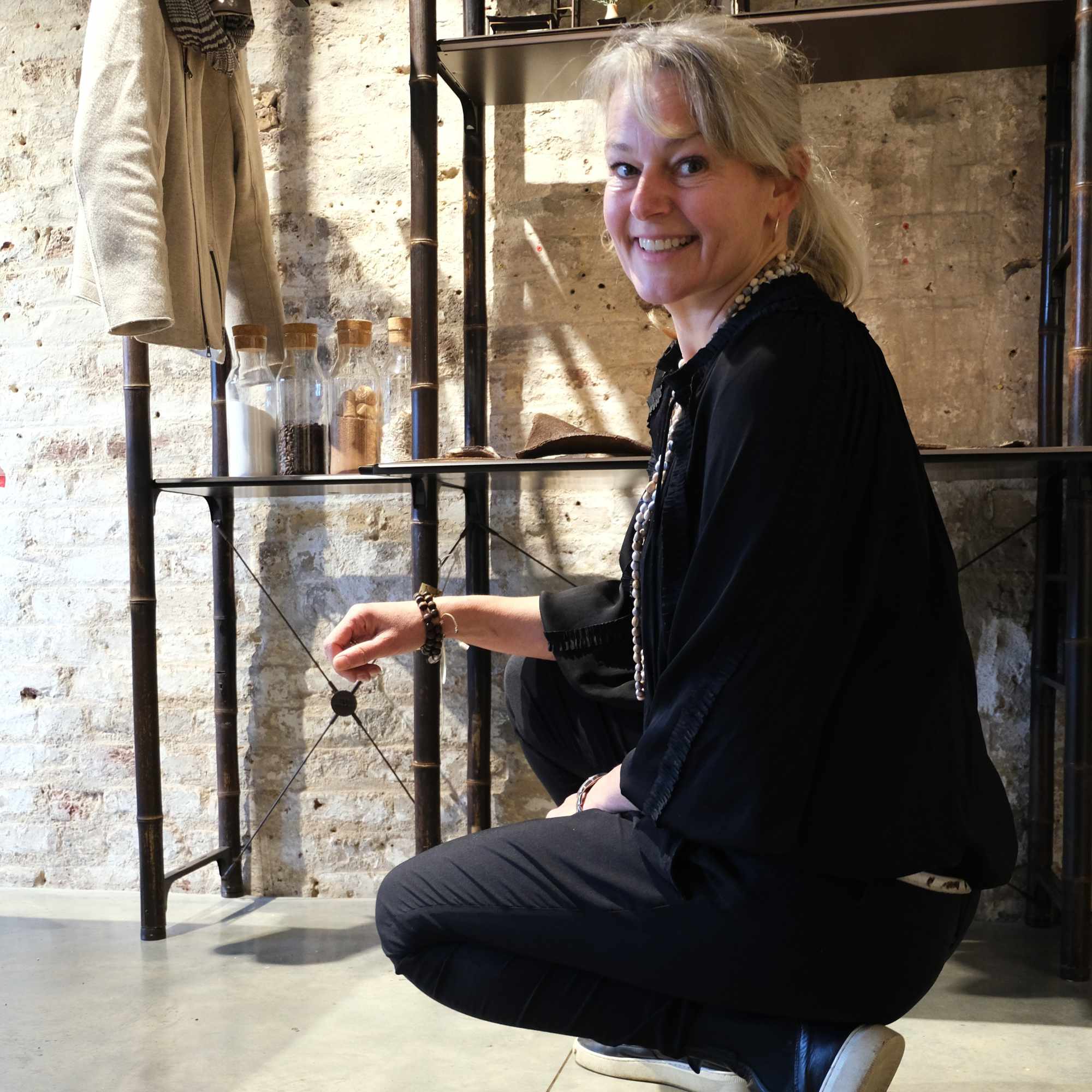
BA Product Design, Ravensbourne University, 2025. Vita Onesta is a material-driven project, arising from designer Anna’s commitment to regenerative resources and thoughtful design. It features is a versatile modular shelving unit which can become a desk, a wardrobe, a TV unit, a chest of drawers, a table and/or a room-divider. It is made of raw bamboo poles, with shelves of hemp, cork, along with innovative composites made from used coffee grounds. There is no glue or formaldehyde. “As an avid coffee drinker, I saw a poetic solution in transforming my own daily waste into functional design.” Anna, who has a background in banking and interior design, was inspired by Dieter Ram’s Vitsoe 606 universal system. Sustainable design, she says, extends far beyond the use of natural materials. “Design should of course embrace function, materials and good looks. But it should also include durability, versatility, inclusivity and the ability to be repaired. And I also believe that high-end, functional design can coexist harmoniously with environmental responsibility.”
Through her new practice, Studio Onesta, Anna will focus on underutilised materials such as hemp, alongside linoleum and aluminium, to craft future collections
Charley Softley
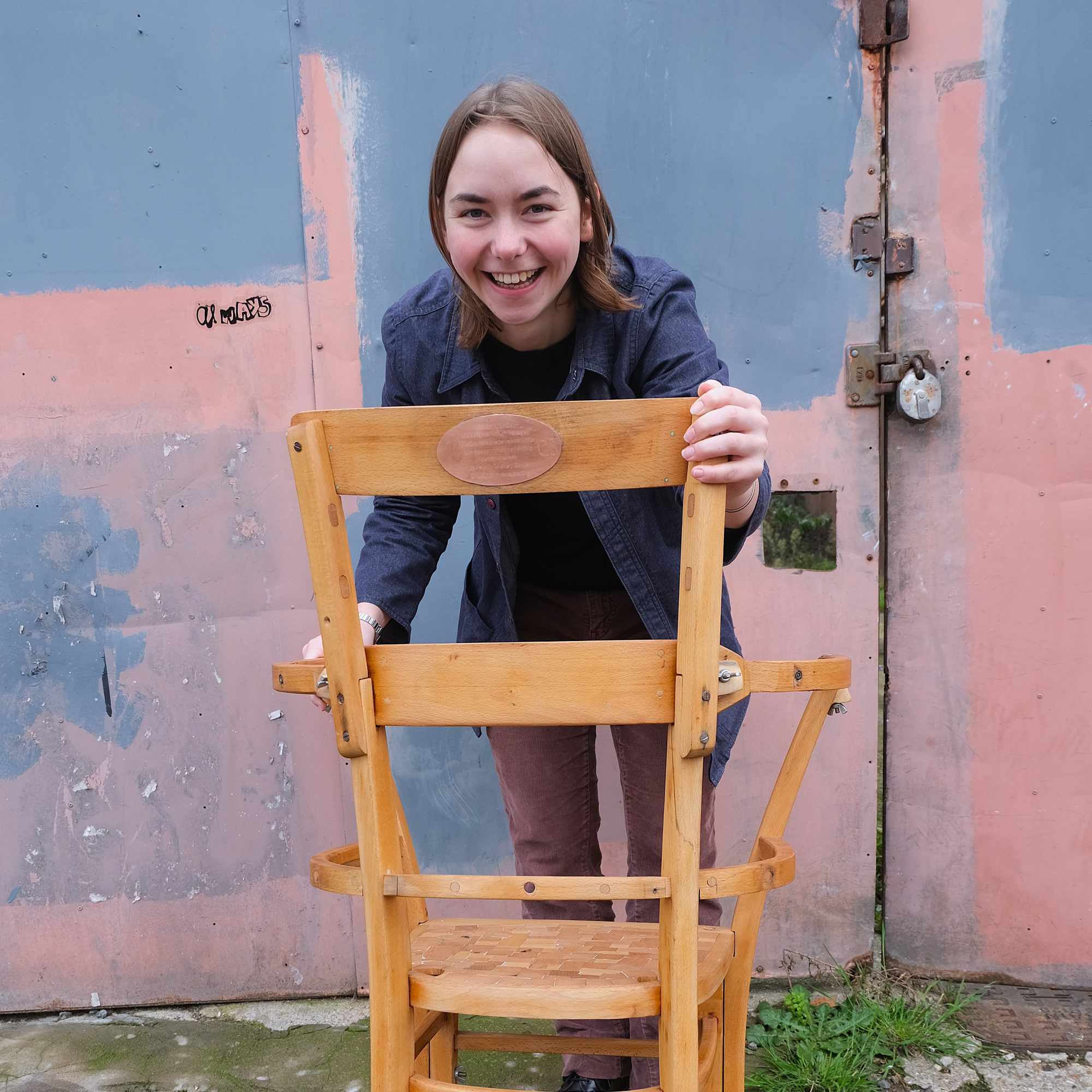
3D Design and Craft, University of Brighton, 2025. Charley hunts around outside for thrown-away bits and pieces as materials for her distinctive and original furniture. She calls calls it “urban foraging.” An example is the Retyred Chair. This is crafted from discarded unsalvageable bike frames and reused inner tubes – “a functional, tactile celebration of creative reuse.”
Charley has also made The Chair of Chairs. This is built from broken beech chair parts and reused hardware – “questioning our throwaway culture and combining traditional craft with sustainable making.”
Additionally, Around the Block is a modular inflatable pouf made from reused bicycle inner tubes woven around a steel frame – “highlighting waste in the cycling industry, and a reflection on consumption and sustainability.” Charley won the New Craftmaker Award at New Designers 2025. The judges said: “We found Charley’s work playful and full of innovation – a new exploration in vernacular furniture.”
Elsa Parrot
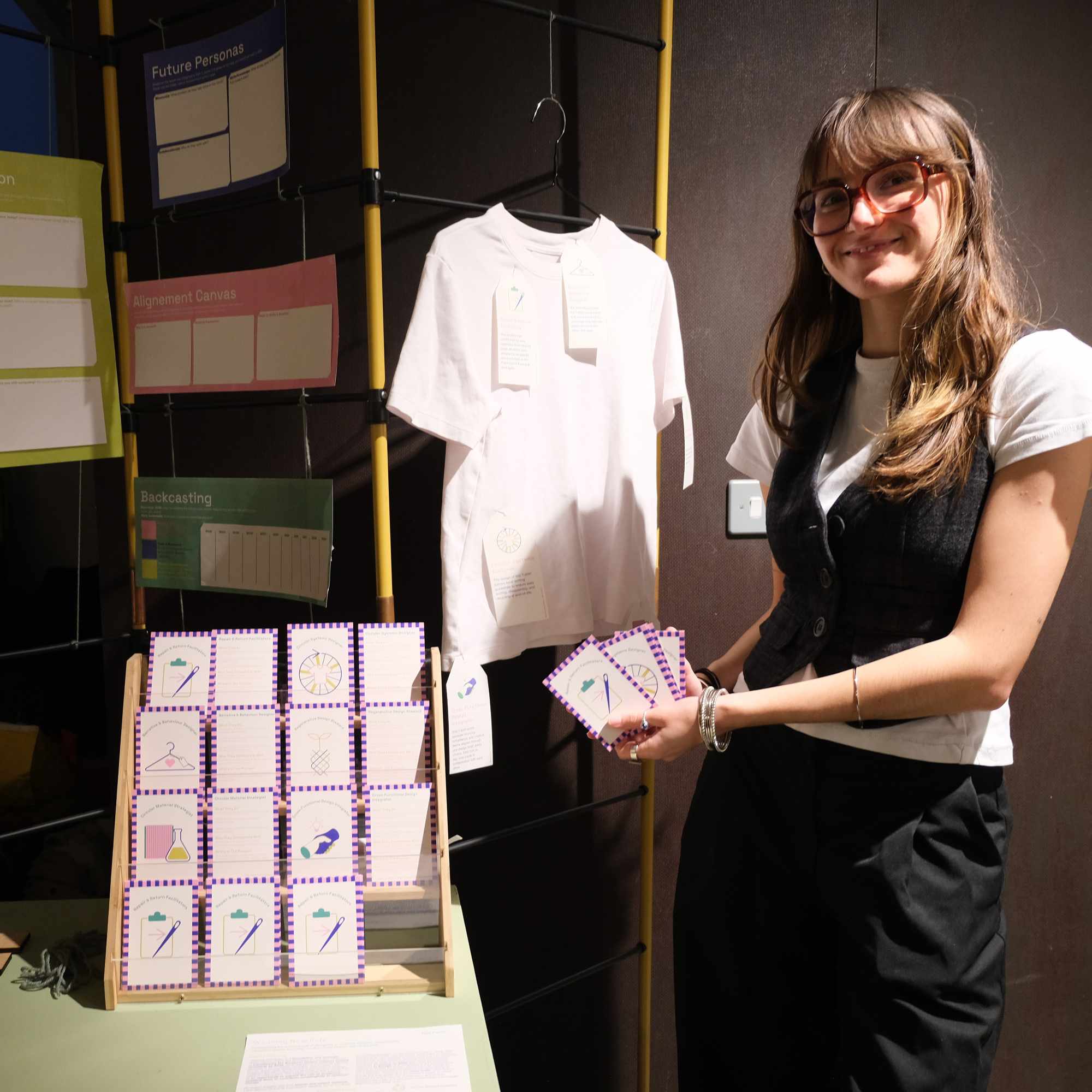
MDes Design Futures, Royal College of Art, 2025. Elsa’s project Weaving New Roles, based on extensive research and interviews, dramatically expands the role of the designer, beyond simply a creator of product to become an agent for changing systems within medium-to-large European fashion brands. By 2035, in a “preferred future,” the fashion industry would be fully aligned with stringent EU eco-regulations. Garments would be designed for durability, and for ease of repair and recycling. Circular services such as repair, resale, and take-back would be standard practice. Supply chains would be increasingly local, transparent, and even regenerative. Accordingly, designers would now have new roles as strategic, cross-functional agents, shaping not only products, but the systems that sustain them.
“I show that design can engage with environmental complexity, not just through the use of sustainable materials, but by challenging the structures and behaviours that underpin systems of production and consumption. My work spans many industries – but fashion is a favourite focus, with its rich intersection of cultural, ecological, and economic issues.”
Funmi Olawuyi
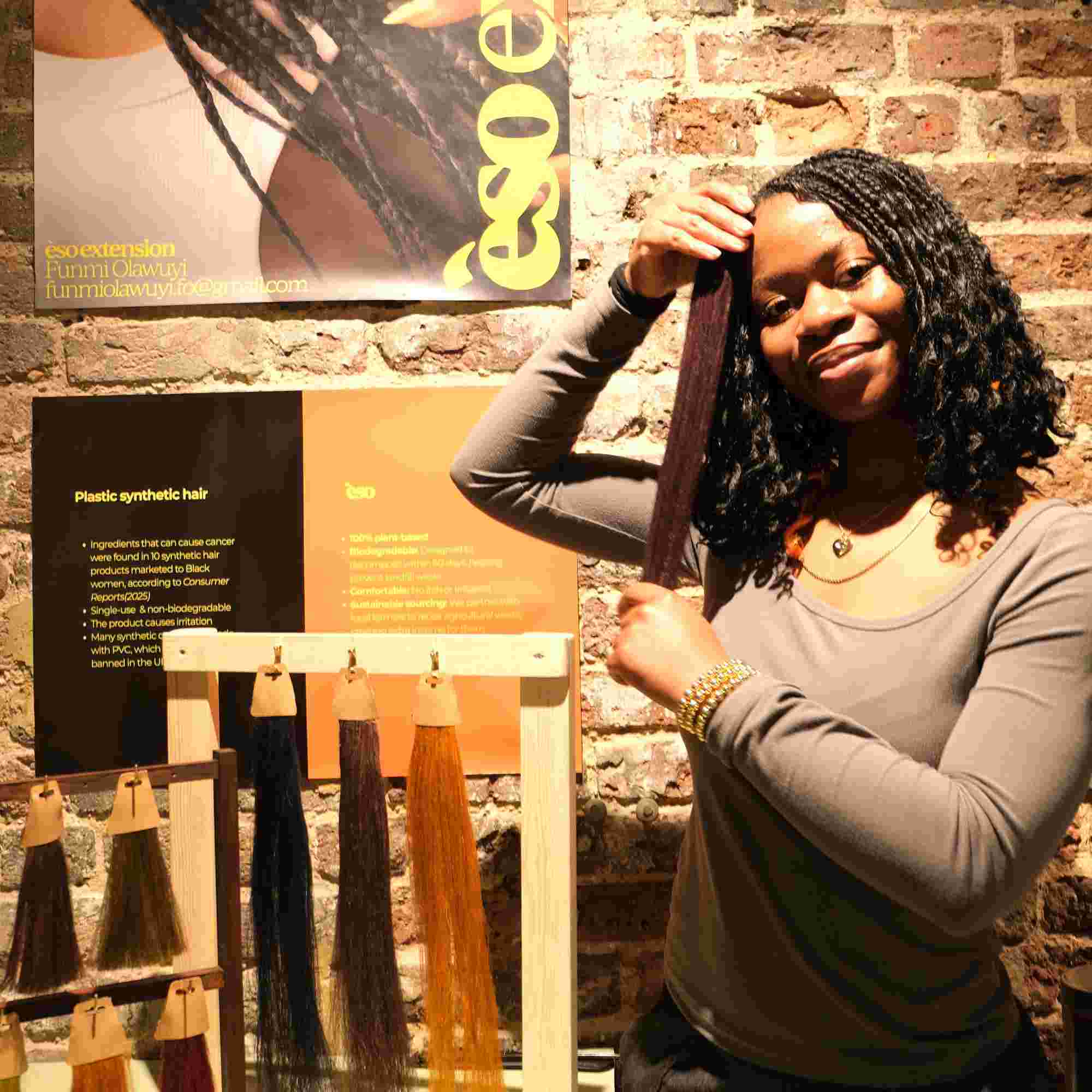
BA Product and Industrial Design, University of the Arts London, 2024. Funmi’s èso hair extensions are plant-based, making them an eco-friendly alternative to the synthetics which flood the market. Crafted from pineapple leaf fibre, using natural softeners and plant-based dyes, èso extensions have the appearance of hair – but without harmful chemicals. Additionally, repurposing agricultural waste provides farmers with extra income while reducing carbon emissions—using one metric ton of pineapple leaves saves approximately 2.4 metric tons of CO₂ according to EcoPALF, a pineapple textile supplier.
Says Funmi: “Historically, cosmetic products for black women have posed serious health risks, from hair relaxers and skin-bleaching creams to make-up with traces of cadmium or lead. My question was simple: how can I design better beauty products for black women? I have worn hair extensions since the age of four… and then I discovered they were toxic. So I invented èso extensions. And started a movement towards more sustainable and healthier products for women of colour.”

Hinna Khan
BA Product and Industrial Design, Central Saint Martins, University of the Arts, 2025. We formed our GREEN GRADS Wool Hub in 2022, and since then many of our textile designers have called attention to the low price that farmers get for their sheared wool, which is as a result is often burned or buried as waste. But Hinna brings a fresh perspective, suggesting a new use for waste wool within the electronics industry, which currently relies heavily on synthetic, extractive materials, fuelling a mounting global e-waste crisis. “We are overlooking the exceptional technical properties of natural fibres,” says Hinna. Wool is naturally conductive because around half of it is carbon. Accordingly, she is using it for her WoolTech circuit boards. Mixing wool with a substrate (in this case milk) makes it solid, and it can then be laser etched to trace conductive circuit paths. Circuit board components can be mounted directly using a water based solder. Subsequently, components can be removed simply by placing the circuit board in water. Electronic components can be directly recycled and used for other projects while the board can be cleaned, sanded smooth and re-etched. This creates an infinitely reusable PCB (printed circuit board) for electronic projects. Hinna won the MaDE Materials Innovation Prize at New Designers, 2025.
lestyn Howorth
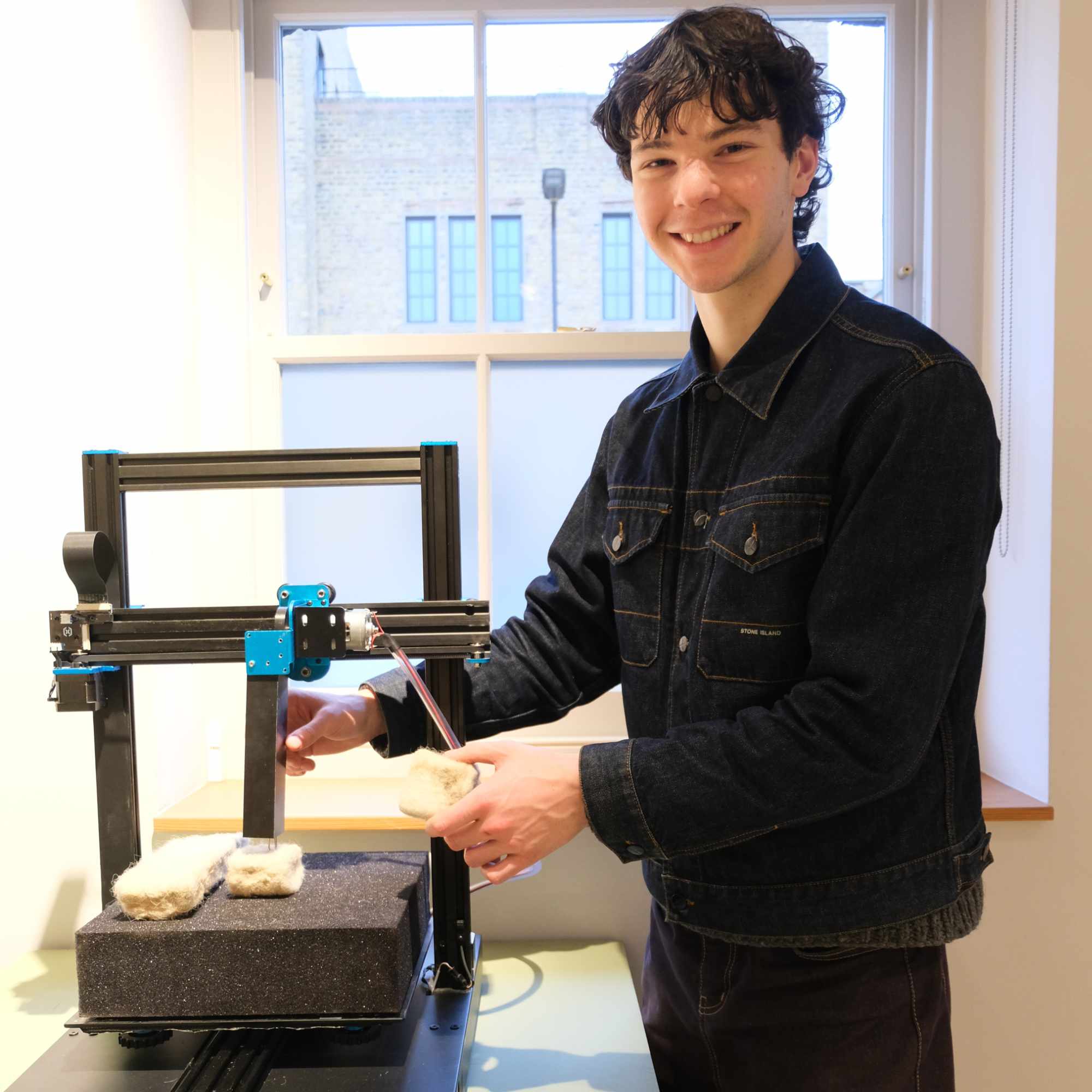
BDes Product Design, The Glasgow School of Art, 2025. In Scotland today, it costs more to shear a sheep than the market price of its fleece, often leaving farmers with no option but to burn their wool. Iestyn’s Herd Wool 3D Printer has been designed as an alternative. It is a custom-built 3D felting machine that compacts low-value wool into precise, functional forms using 3D printing software. This could create a regenerative system that re-establishes wool within rural economies. As an example, the printer could produce moulded inner packaging, a biodegradable alternative to conventional synthetics. “Through Herd, the printer could be a catalyst for new rural relationships between land, labour, material and technology.”
As graduate Design Resident at The Glasgow School of Art, Iestyn is strengthening the Bio Lab and tools for biomaterials, while developing the Wool 3D Printer for market. He also runs Soft Structures, a hands-on weaving workshop that uses Scottish wool to explore collective making and material understanding. Iestyn won Chair’s Medal for Innovation and Technology, Glasgow School of Art, 2025. He also won The Glasgow School of Art Sustainability Degree Show Prize, 2025.
Izzy Kelly
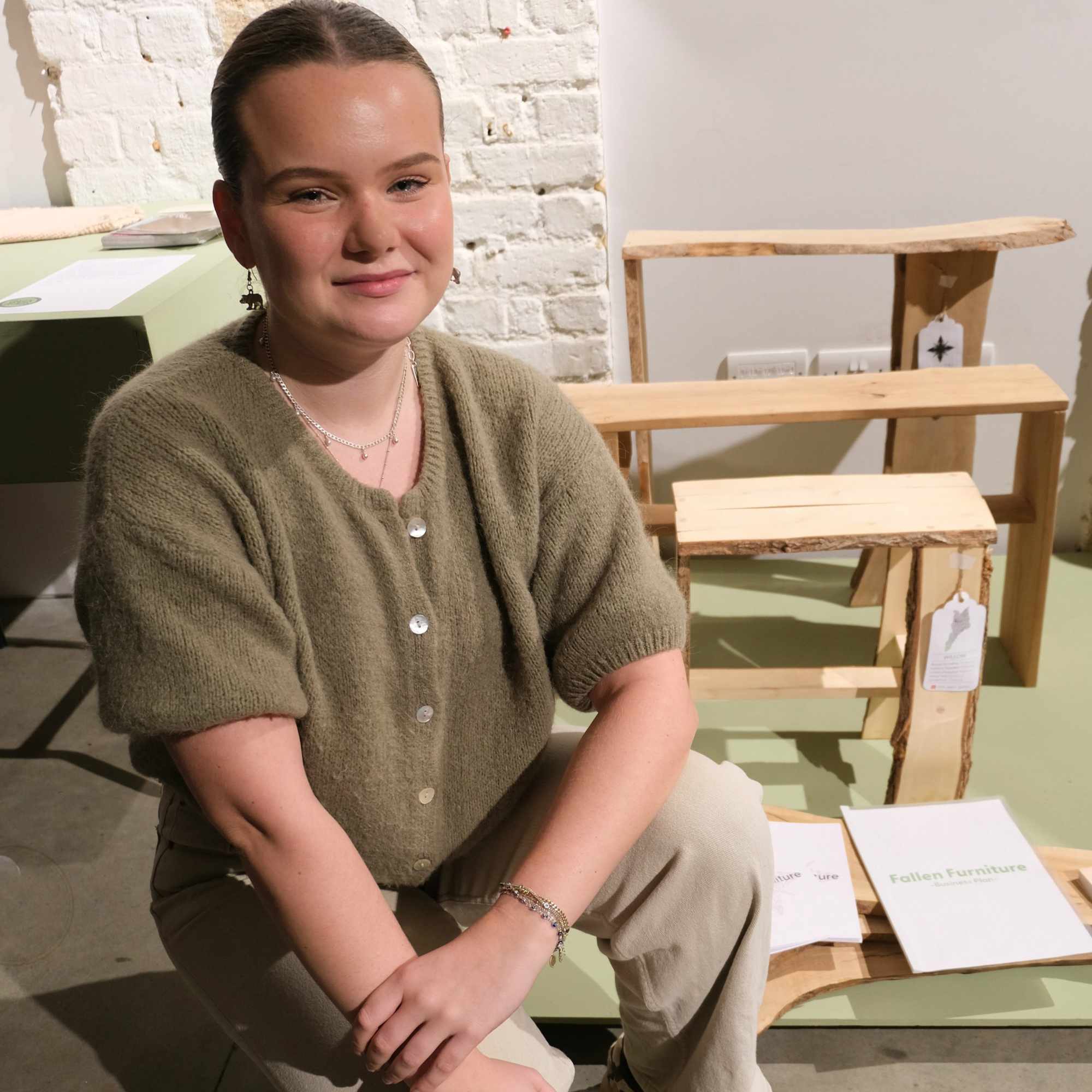
BA Product and Furniture Design, Kingston University, 2024. The UK is the third biggest importer of timber worldwide, yet is one of the world’s most nature-depleted countries, in the bottom 10% globally for biodiversity. Furthermore London councils alone fell over 5,000 trees a year, which are mostly chipped or burnt with consequent release of carbon back into the atmosphere. And flawed schemes for timber certification allow illegally sourced timber to be sold globally. Izzy’s Fallen Furniture project calls attention to these shocking statistics. Her collection is made from waste timber from within a two-mile radius of Kingston University (where she has been studying). “After contacting local tree surgeons, I was inundated with logs, all completely free, saved from chipping/burning, and transported to the workshop by foot to eliminate carbon emissions.” Her simple design allows the unique qualities of each piece of timber to shape how the furniture looks and functions. Just one design for a multi-purpose stool/table/shelf can be modified to suit the timber collected – allowing the beauty and individuality of each log to shine through. Finally all furniture is engraved according to the What3Words global location system for transparency and provenance.
Jenna Handley
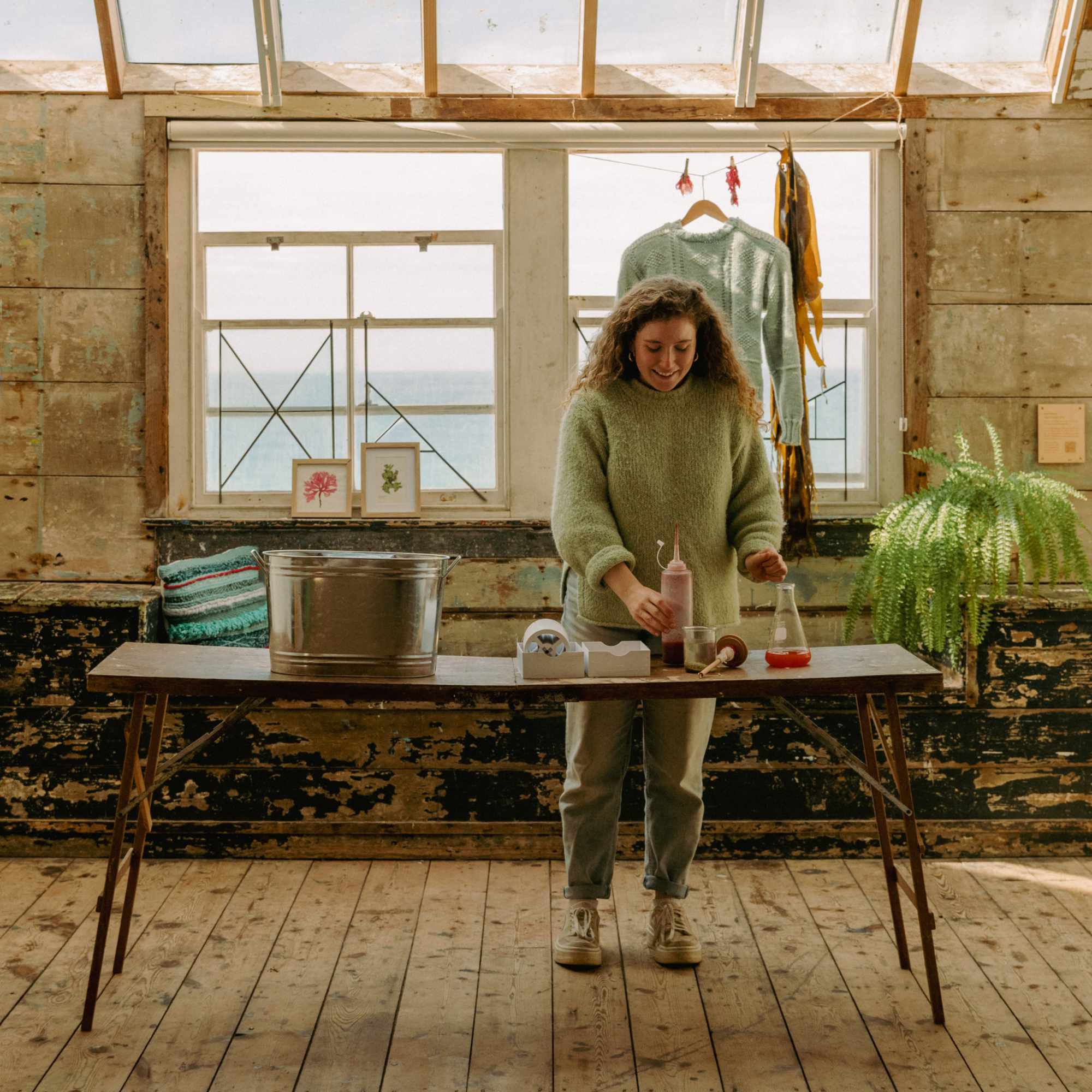
MA Biodesign, Central Saint Martins, University of Arts, London, 2025. Seaweed is a regenerative, renewable, and potentially local resource, which supports marine biodiversity and strengthens climate resilience. Fast-growing and carbon-sequestering, seaweed requires no fresh water or arable land and supports rich underwater ecosystems. Jenna’s brand Seafolk presents Cornish seaweed as a local, sustainable and regenerative natural dye and biomaterial. Rooted in place, craft, and community, the project partners with local knitters to revive regional resources and traditional sustainable heritage techniques, such as knitting the Cornish Gansey jersey. “I am highlighting how indigenous knowledge, traditions and local resources can become models for regeneration.” Jenna plans to visit communities around the world, engaging with their traditional techniques, resources and practices in exchange for knowledge of her biomaterials, documenting her travels by journaling and on social media
Katherine Soucie-Douglas
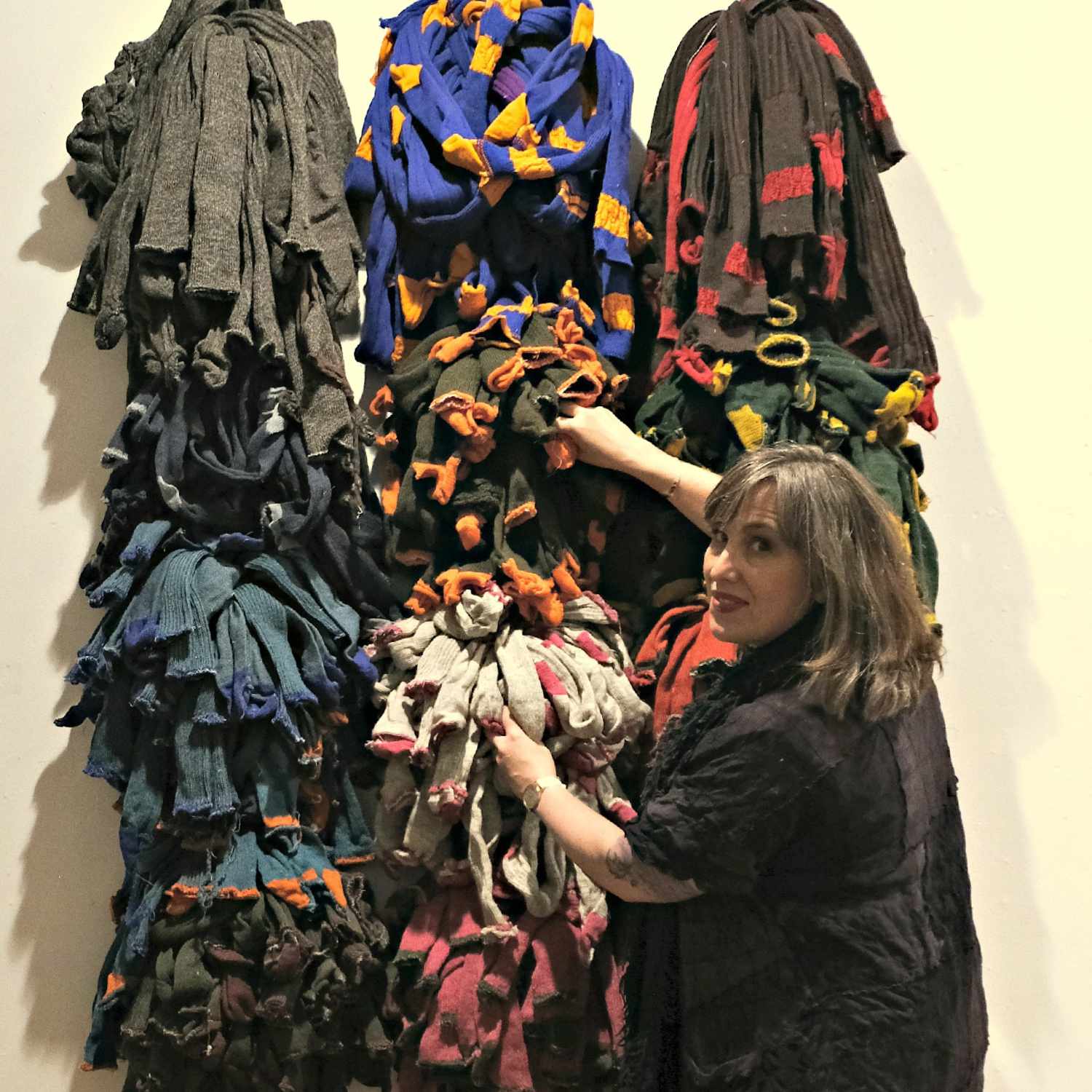
PhD, Kingston School of Art, Kingston University, 2025. Katherine’s practice-based upcycling research, as presented in her PhD New Geographies of (Re)making, is underpinned by extensive and creative hands-on textile experimentation with pre- consumer sock waste and wool, previously in Canada, and now in London, where she is supplied by UK mills. Her philosophy of “Up-Cycology” extends principles of creative textile re-use beyond materials into all aspects of making, including design, techniques and equipment. It proposes, for example, the use of obsolete textiles and machinery. Industry partners include Innuiio, Huddersfield (Noutextil upcycled yarn); Re_considered – Fabreco, Salisbury (buttons and composites); Bristol Weaving Mill (Noutextil upcycled yarn blanket community weaving production); and Junele, Dundee (wool paper composite).
Katherine is creating the Centre for Upcycling Innovation, with an online hub/resource to foster and support creative reuse within textile and fashion design practices.
Lydia Hill
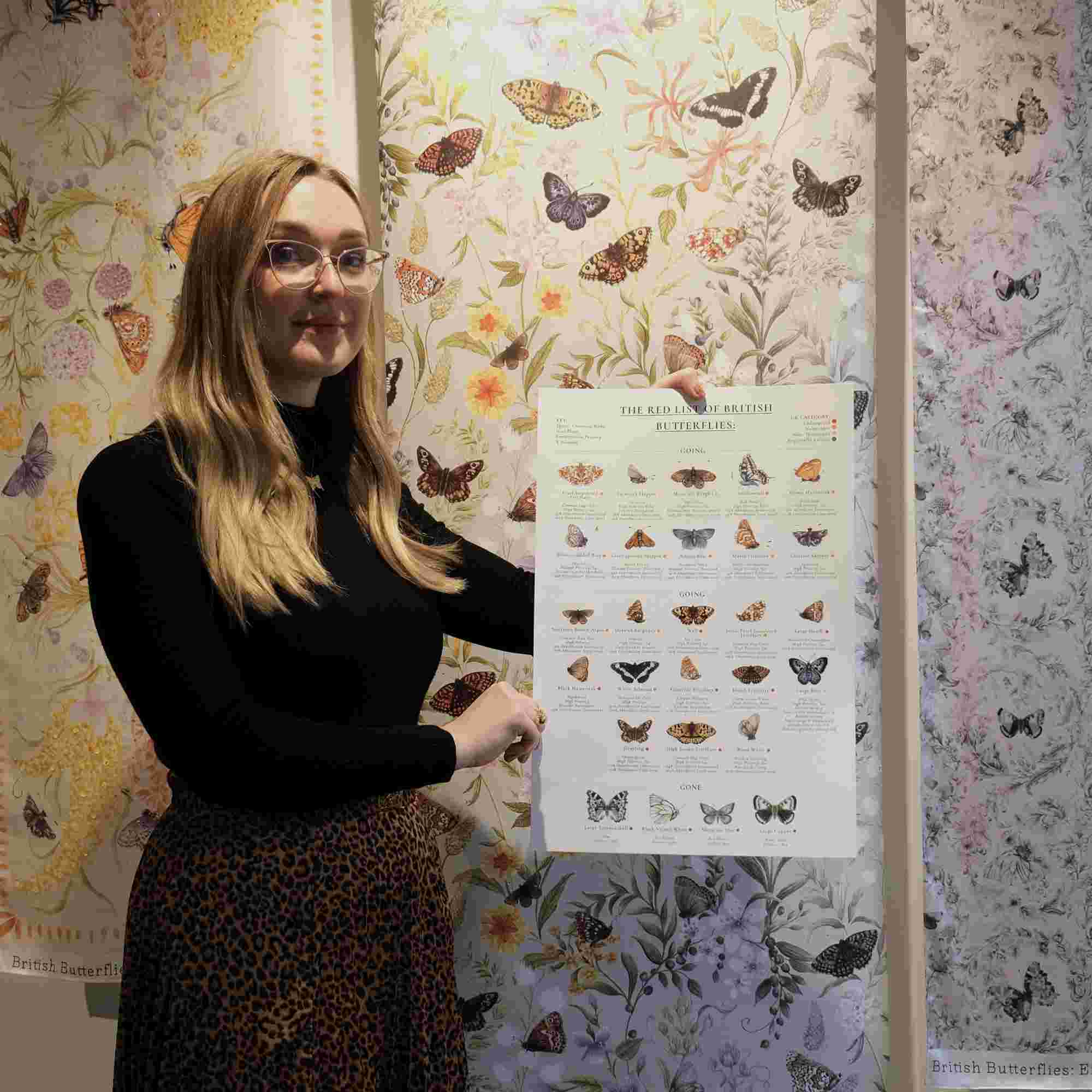
MA Textiles, Royal College of Art, 2025. Lydia calls her textile portfolio Going, Going, Gone, stating that her designs are “gentle activism” drawing attention to the British butterfly crisis. Using handmade natural ink, she has meticulously depicted three main groups on the Red List of British Butterflies: the vulnerable, the endangered and the extinct, together with their host plants. “To mimic this loss of life, I have made a pictorial timeline where the designs fade out. My vulnerable design is bright colours with embellishments, the endangered design begins to fade and lose colour, whilst the extinct design is in monotone that vanishes to white. It’s a deliberately stark contrast.” Spreading awareness in this softer way, she says, can reach people who may have previously shut out more strident environmental messages through fear or worry. “An uplifting print design can gently draw people in.”
Mandy Roland-Smith
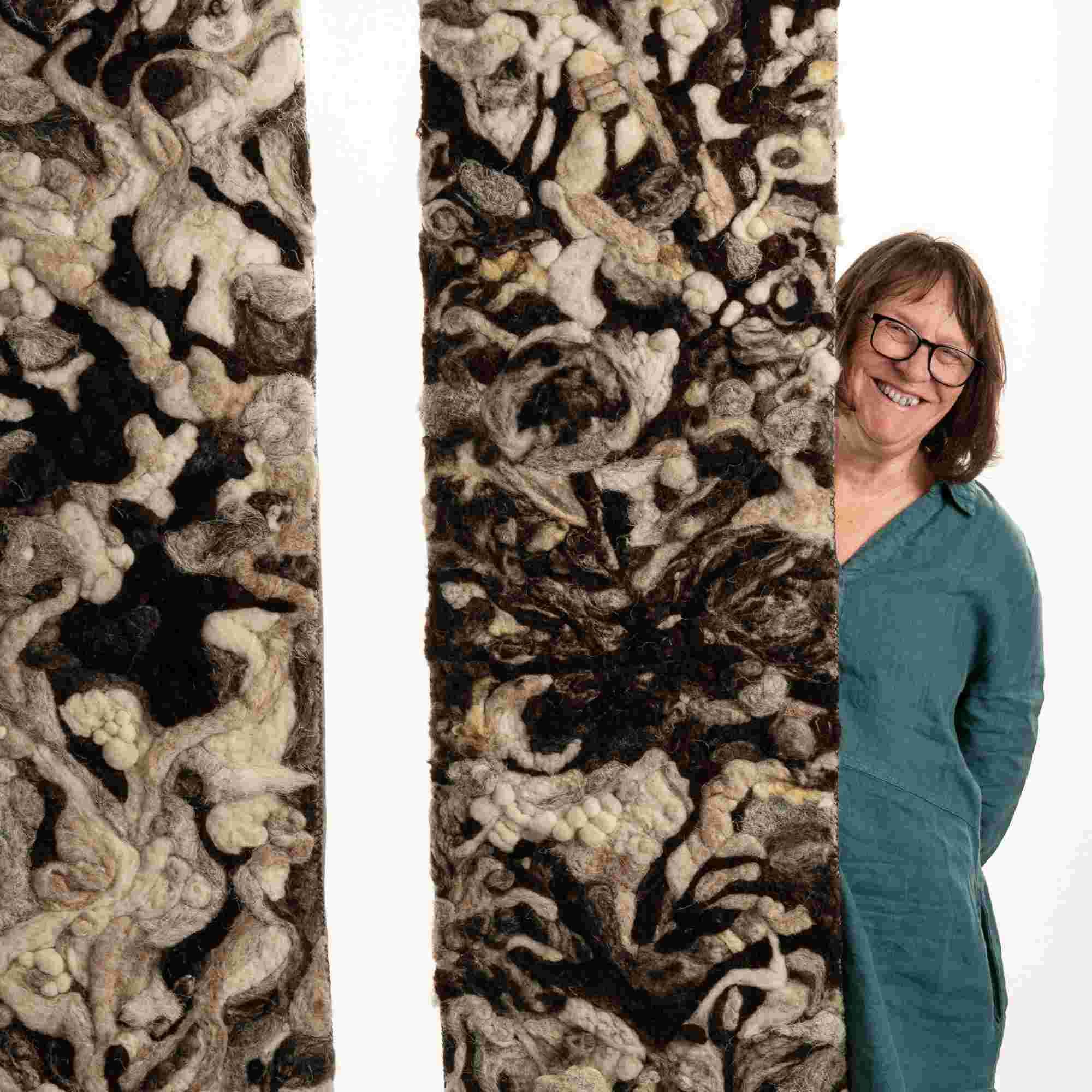
BA Contemporary Design Craft, Hereford College of Arts, 2025. Wholly sustainable and regenerative, Mandy’s panels and sculptures are needle-felted on a large scale. She uses fleeces from a six mile radius of her home and dyes from local plants to reflect the circular life cycle of the natural world in which everything is interconnected and will eventually return to enrich the earth. “Needle-felting allows me the material intelligence to work fluently and from my guts.” Mandy embarked on a six year part-time degree at the age of 68 after a career as a counsellor, art therapist and psychotherapist, graduating at age 74. “And I plan to have an active art career making and exhibiting.” She is building a network of artists who put sustainability at the centre of their practice, leading perhaps to collaborative projects.
Mandy won her college degree show Award for Sustainability, and has exhibited her work in Hereford Cathedral. Interior/Exterior World
Neve Beill
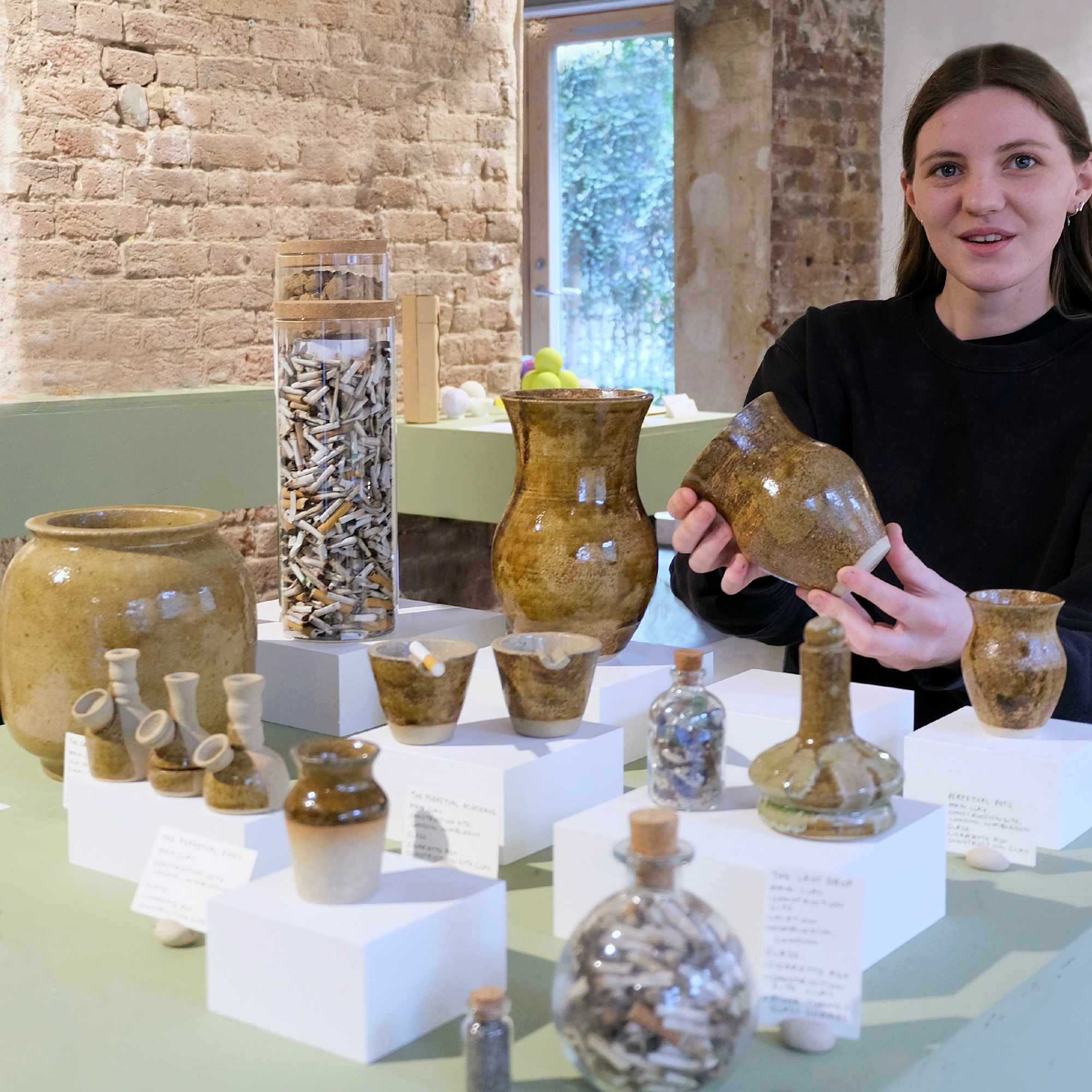
BA Product and Furniture Design, Chelsea College of Arts, 2025. Neve has developed a glaze from cigarette ash (collected from local pubs) for vessels made from clay from a local construction site to show that ceramics can be made with repurposed materials – “I’m transforming discarded substances into something meaningful and enduring.” The name of her collection is Perpetual Ash.
Neve was expelled from school at 15, and began making at an early age, before finding her way back into education to complete A levels and her degree. “This unconventional path has made me a determined and curious maker, teaching me to adapt and constantly experiment. A negative in my life has led to a compulsion to create and understand through trial and error.” It is this curiosity that has shaped her work.
Neve received the Cockpit Studios Make It Award 2025, providing fully-funded studio space for two years, plus business support. “This has given me confidence and more time for my work.”
Noé Chouraqui
BA Product and Industrial Design, Central Saint Martins, University of the Arts, 2025. There are over 300 million tennis balls produced each year. They generate around 20,000 tons of waste, most of which end up in landfill where they can take up to 400 years to decompose.
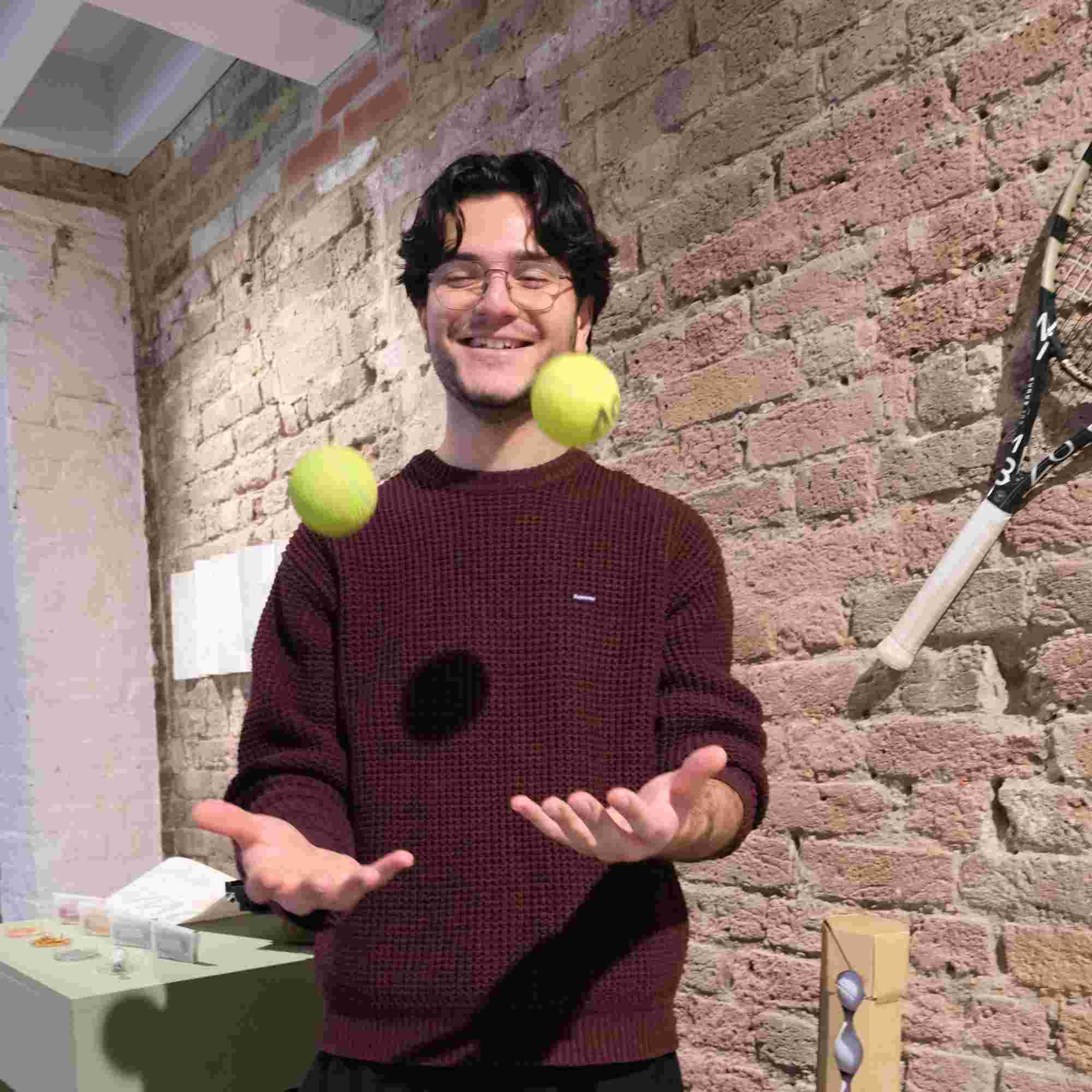
Noé has been playing tennis since very early childhood. He questions why a ball, so central to the sport, should have such a short lifespan. “Why couldn’t we have one tennis ball that lasts for years?” Accordingly he has invented POINT. This is a 3D-printed, pressureless tennis ball made from PLA-HR, a recyclable bio-based filament. Here, through redesign of the internal structure and manufacturing process, is a sustainable, high-performance alternative to a conventional ball, which is 90% more eco-friendly. POINT has been tested by the International Tennis Federation (ITF) for performance and durability.
“My goal is a commercial 3D-printed tennis ball with ITF certification. Within the tennis industry, this would truly herald a more responsible way of playing the sport.”
At New Designers 2025, Noé won the Design for Planet Award from the Design Council and the Design Innovation Award from DS Smith.
Ollie Stroud
BA Product Design, University of Edinburgh, 2025. Ollie has made his elegant Mara tableware collection from shellfish waste. “An abundant industrial waste-stream becomes a resource, encouraging discarded material to be viewed through an opportunistic lens.” This project, says the designer, is “a circular vision for the future.” It gives new life to shellfish waste, transforming it into sustainable materials for design and construction. “Driven by a passion for material innovation, I developed a new bio-composite to reshape how we make and build. Because design should not only create objects but also encourage others to embrace circular thinking and more sustainable practices.”
Peerasin Punxh Hutaphaet
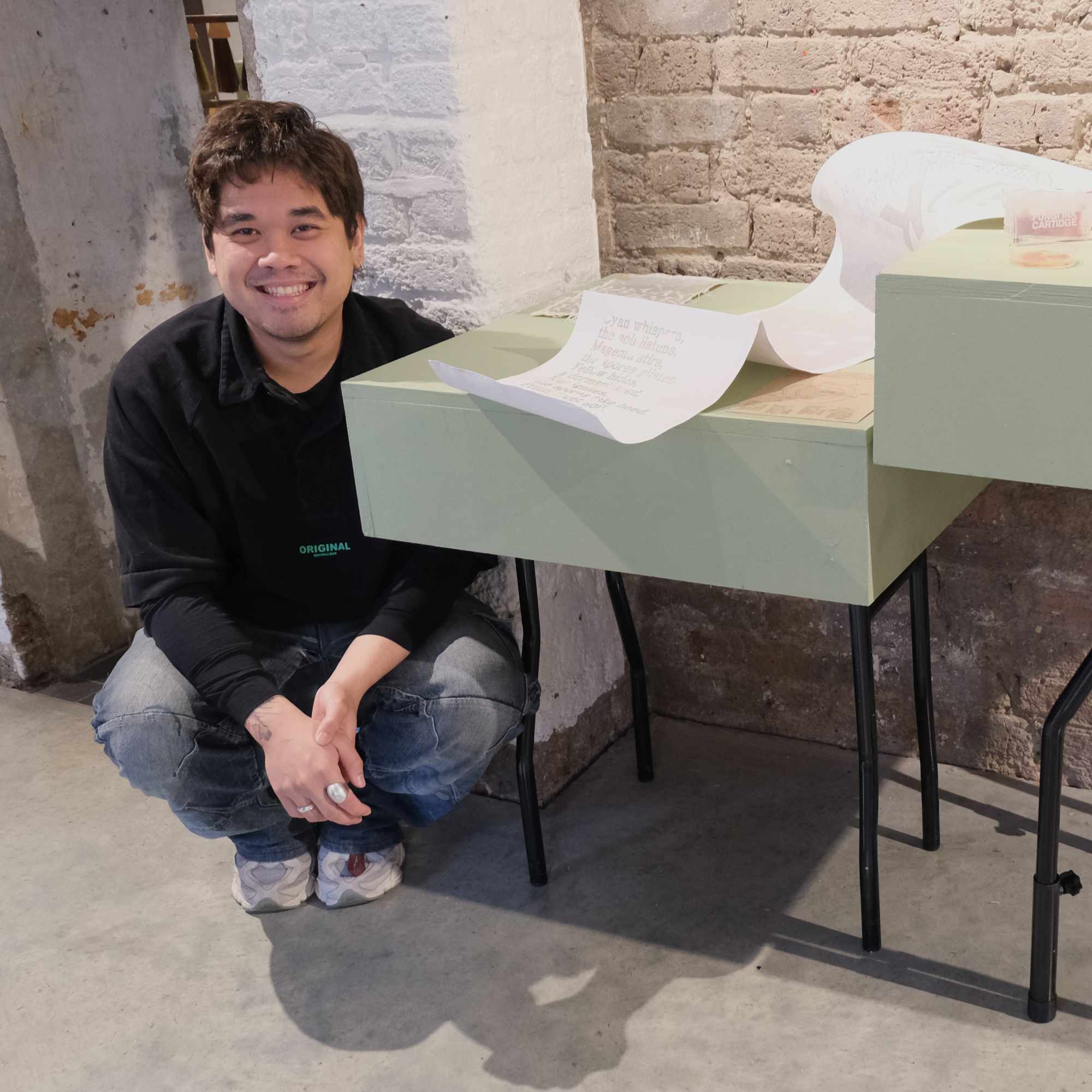
MA Material Futures, Central Saints Martins, University of the Arts, 2025. Modern printing, says Punxh, “immortalises waste”- trapping materials beneath petrochemical ink. Accordingly, he has invented GROWinK – a “living” printing ink that merges fungi pigments and soil-safe bacteria to print biodegradable images on paper, fabric, and eventually synthetic plastics. Colour becomes a biological system that fades and decomposes waste instead of preserving it. Punxh calls this an “ecological act” for “designed disappearance.” Intended for polymer-based materials that are difficult to break down, GROWinK turns static communication into an active ecological cycle. “It’s the first bio-ink designed to consume the medium it prints on, turning posters, fabrics, or plastics into living systems that eventually decompose.”
Rahat Rai
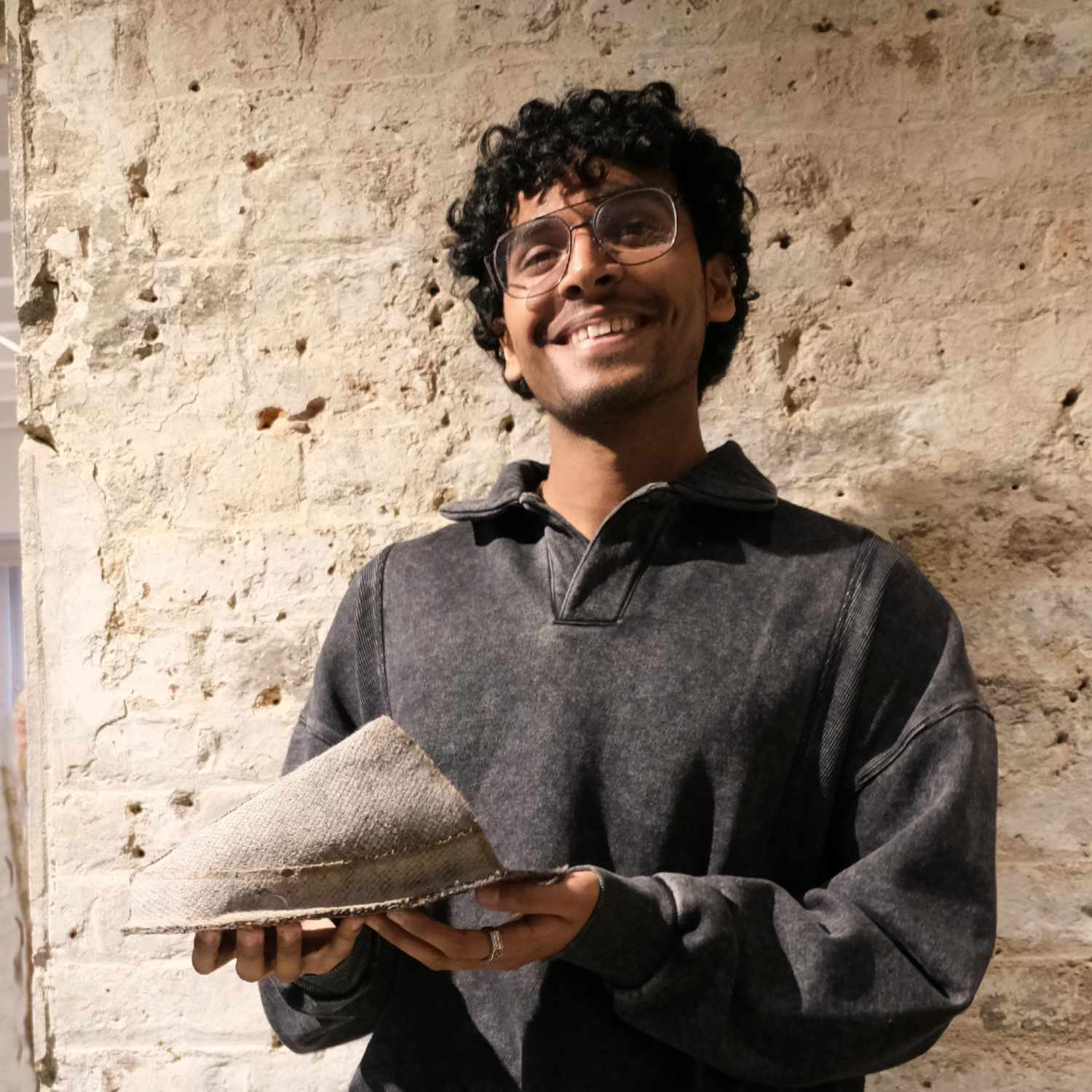
BA Product Design, Ravensbourne University, 2025. In his project Done & Duster, Rahat has transformed household dust into a material…and used for a pair of slippers. Made into a fabric with no binders, the fibrous nature of dust bonds it together, and a ripstop-like stitch pattern adds strength. Says the designer: “I am changing the perception of dust as waste to show that what’s casually tossed away can have a value. Household dust is all around us in abundance and is grossly overlooked.” He adds: ”Each bag of dust has its own story and reflects a lifestyle. You can get to know a lot about someone from their household dust such as their eating habits, hobbies, routine, celebrations and so on.” But he adds that people think dust is disgusting. “I want to change that perception by improving my products’ aesthetic appeal and experimenting with natural dyes to add colour. I’m also looking at different processes and at blends and mixes, with, for example, raw wool.”
Ruwanthi Gajadeera
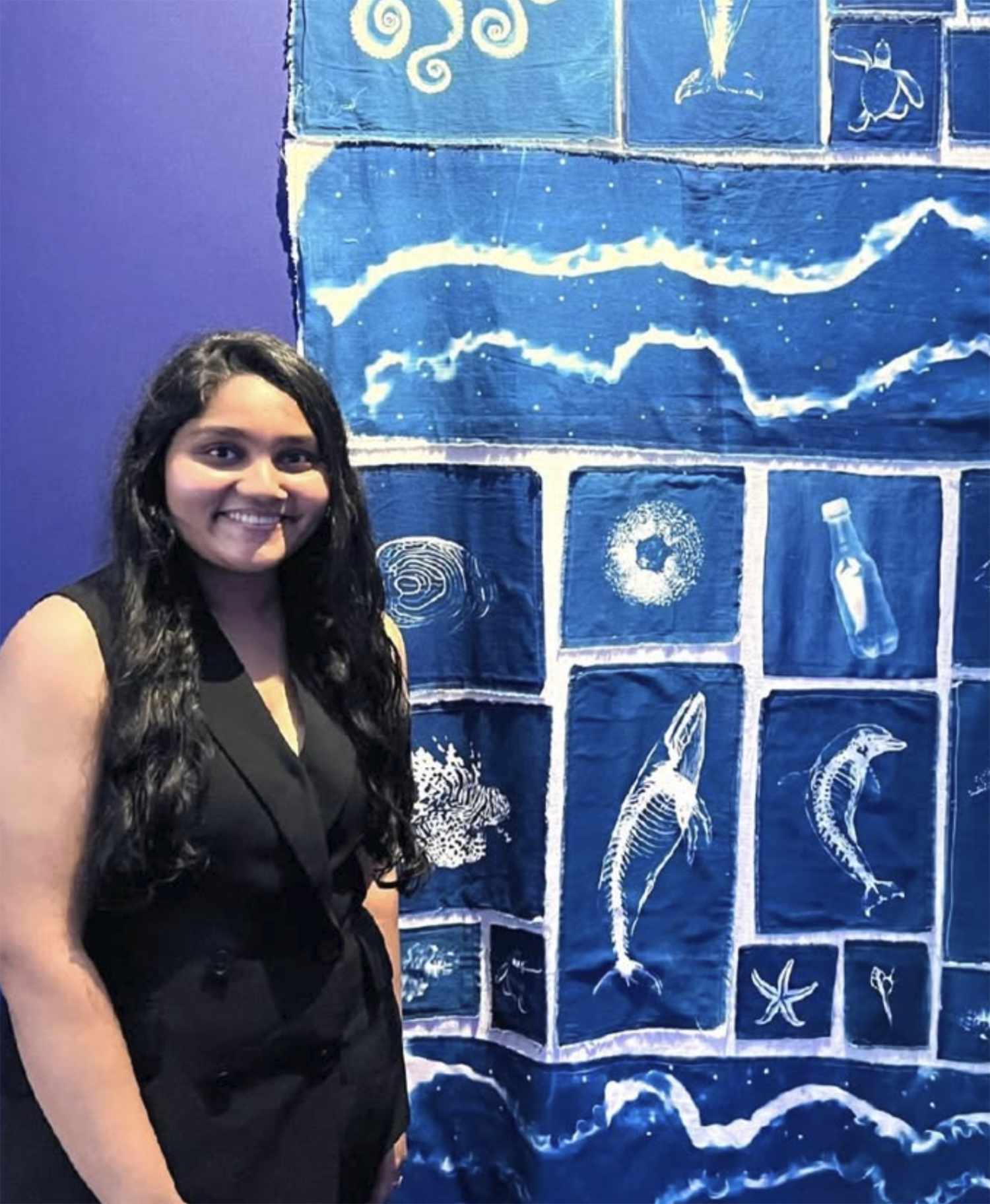
MA Fashion, Royal College of Art, 2025. S.O.S – Save Our Seas. On 20 May 2021, the container ship X-Press Pearl ignited off Colombo. The flames lasted nearly two weeks. The ship emitted hazardous cargo and fuel into Sri Lanka’s coastal waters. It also released billions of contaminated nurdles (plastic pellets) that have poisoned fish, turtles, seabirds, and marine mammals. The damage is still unfolding. This disaster has been the catalyst for Ruwanthi’s “artivism”: her award-winning S.O.S installations (“Save Our Seas) are “an immersive multi- sensory learning experience to connect emotion with ecology.”
Centre stage are the poetic cyanotype tapestries illustrating ocean currents and the fragility of marine life. Their powerful indigo-and-white images are made with a traditional time-intensive photographic process using sunlight and iron salts – “which highlights the delicate balance between ocean fragility and resilience.” Small crochet forms made from reclaimed fibres reference threatened reefs, and olfactory expressions evoke an unpolluted coastline. “S.O.S is a living project,” says Ruwanthi. She plans to deepen its scientific grounding while widening its “sensory language,” working more closely with marine researchers, sound designers, and perfumers.
“I am working with low-impact processes, reclaimed textiles, cyanotype, scent – to add emotion to environmental knowledge – to make people feel, as well as understand. This thoughtful, regenerative practice uses creativity to open conversations about care, craft, and the future of our planet.”
Salma Garana
BA Product and Industrial Design, Central Saint Martins, University of the Arts, 2025. Every year, around 700 billion unused cigarette filters are incinerated, releasing 9.8 million tonnes of greenhouse gases. Salma’s Acetex transforms this waste into a yarn made from cellulose acetate cigarette filters blended with British wool – the first of its kind. It is durable, moisture-resistant, thermally regulating, and naturally acoustic – and thus ideal for Salma’s Acoustate refillable, repairable, and recyclable panels. Through a take-back scheme, materials can be wet re-spun into new yarn, ensuring a continuous lifecycle.
“Cellulose acetate is widely used in clothing, sunglasses, and other products,” says Salma. “Cigarette filters, also made from cellulose acetate, create a massive waste stream – and massive potential. I was told repeatedly by top wool and material producers in the UK that my material was ‘useless.’ Now I have collaborated with Dublin brand Rezero (who up to now have only used waste cellulose acetate for buttons). Here is the chance to expand into a completely new material market.”
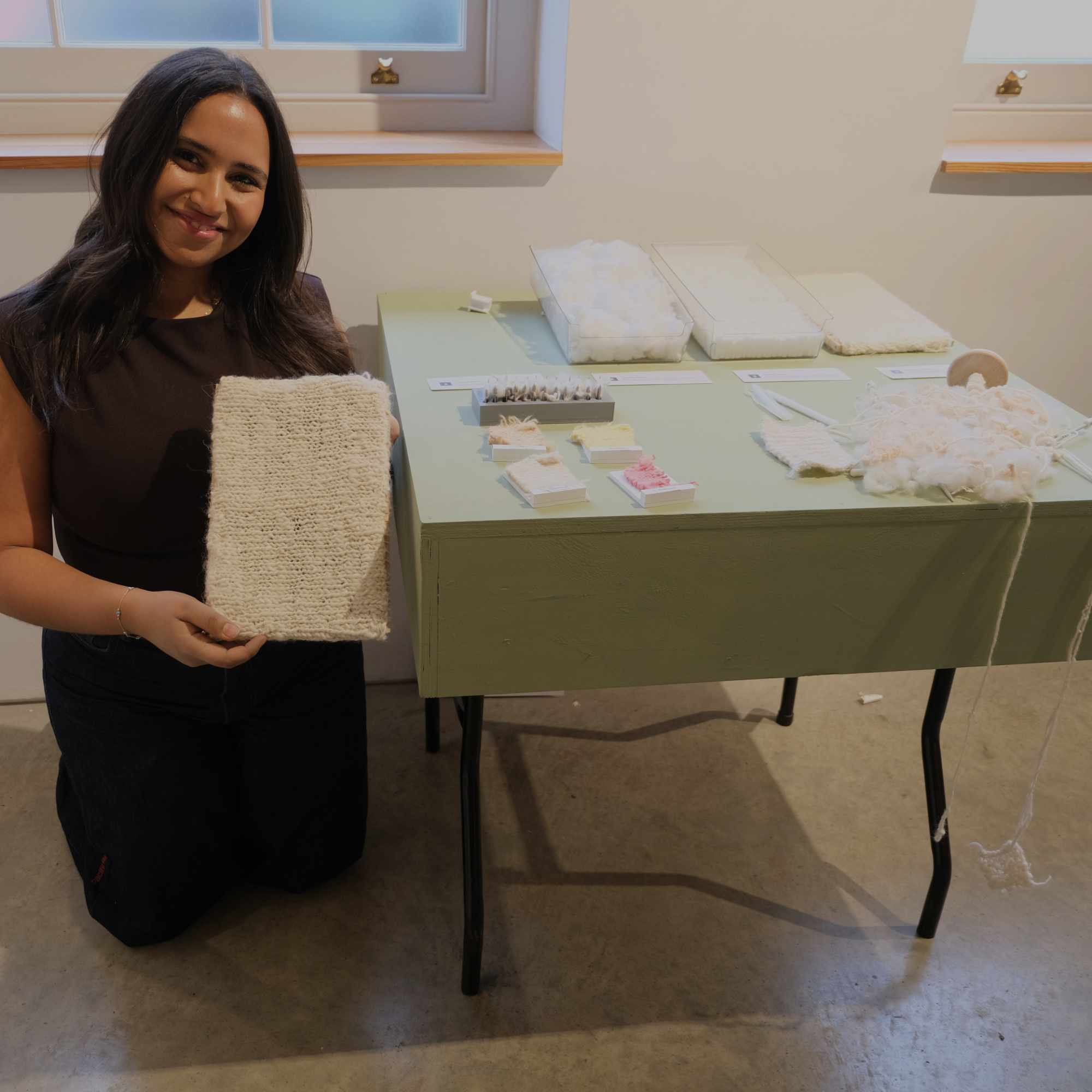
Suzanne Abell
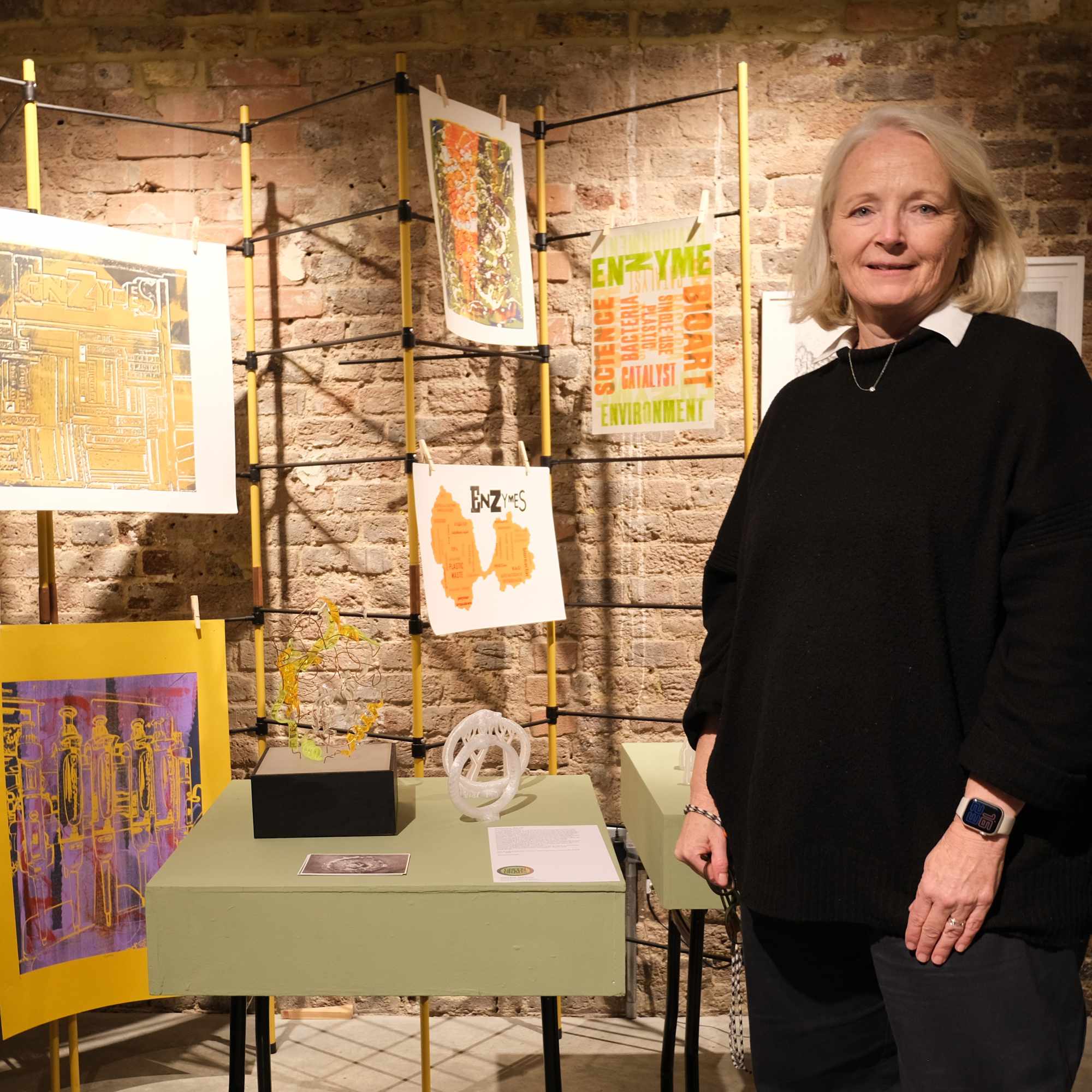
MA Art and Science, Central Saint Martins, University of the Arts, 2025. A newspaper article in The Guardian about bacteria that “ate” plastic was the flash point for Suzanne. Could this be a way to tackle plastic waste? It’s led to an interdisciplinary art practice centred around enzymatic plastic degradation, and in particular the bio-catalytic recycling of polyethylene terephthalate (PET). Basically, this is a unique strain of bacteria that eats plastic waste. “I am using art to translate scientific breakthroughs into statements about sustainability and the circular economy.” Suzanne returned to education and set up her practice after 30 years working for the NHS in Oral Surgery. “My STEM background has helped me navigate the biochemical complexities of recycling plastic with enzymes originally found in bacterium. Creating artworks around this scientific process has been a privilege and shifted my perspective towards environmentally-friendly recycling.”
Suzanne and four fellow graduates hope to form a collective focused on the environment, leading to shows and workshops.
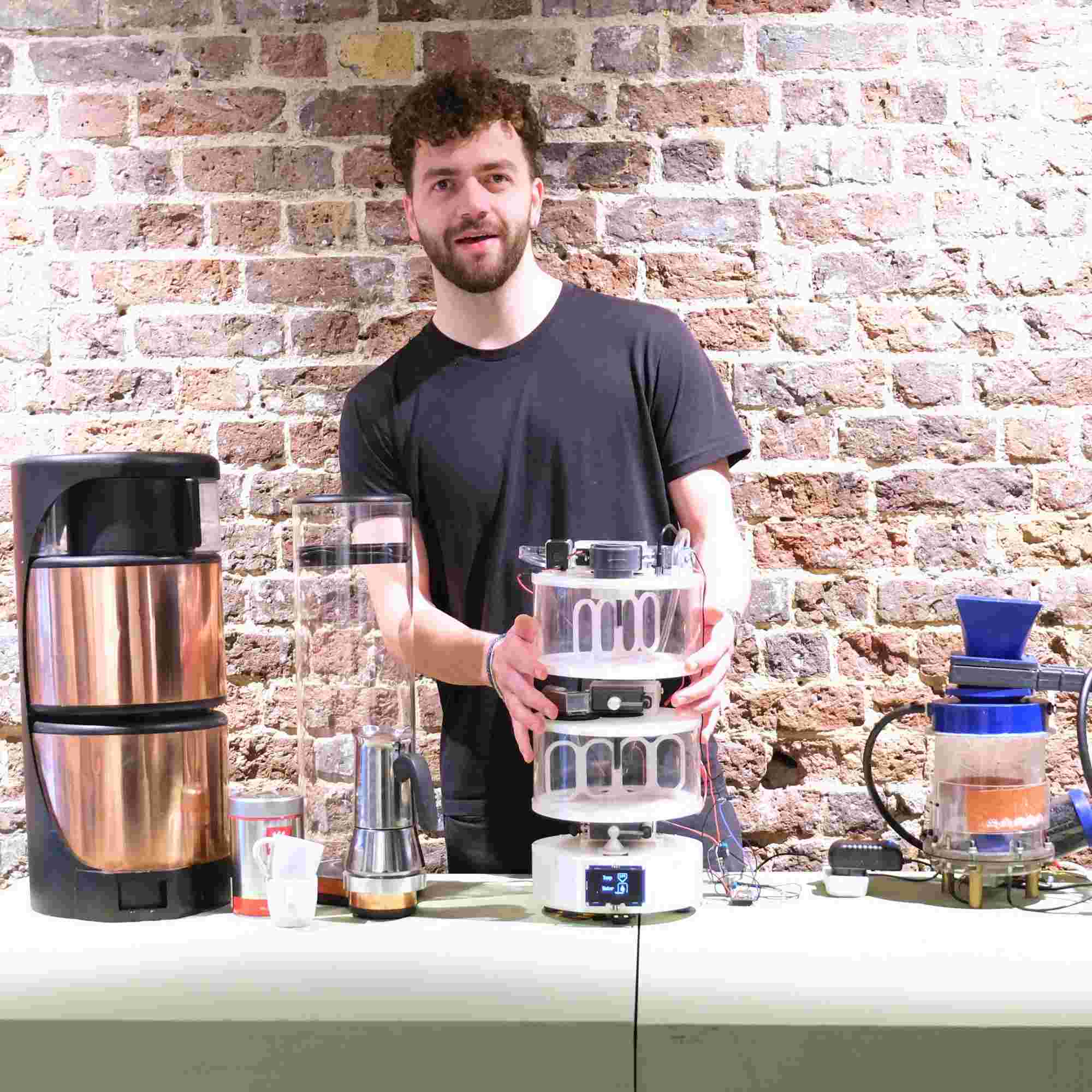
Ted de Turris
BA Industrial Design and Technology, Brunel University London, 2025. What if kitchen scraps could power your cooker? The BioKettle is an elegant counter-top domestic kitchen appliance that converts food waste into biogas through anaerobic (ie without oxygen) digestion, capturing the flammable methane created as food decomposes and using it for fuel. The project offers a decentralised solution to food waste, significantly cutting emissions compared with landfill disposal. Attached to the BioKettle is a cylinder for methane storage connected to a small burner. Ted has worked extensively on the aesthetics as well as the function of his product: “I think the final design is a powerful balance between art, design and engineering.”
The BioKettle has won the Award for Brunel Best Design for Sustainability, 2025; the Dr Richard Bonser Award, 2025; and the Brunel University Alumni Choice Award, 2025.